Invoice with TDS Reconciliation Pattern for India (Section 393 + Form 26AS Matching)
Match invoices against net-of-TDS payments across all deduction sections
What this pattern solves
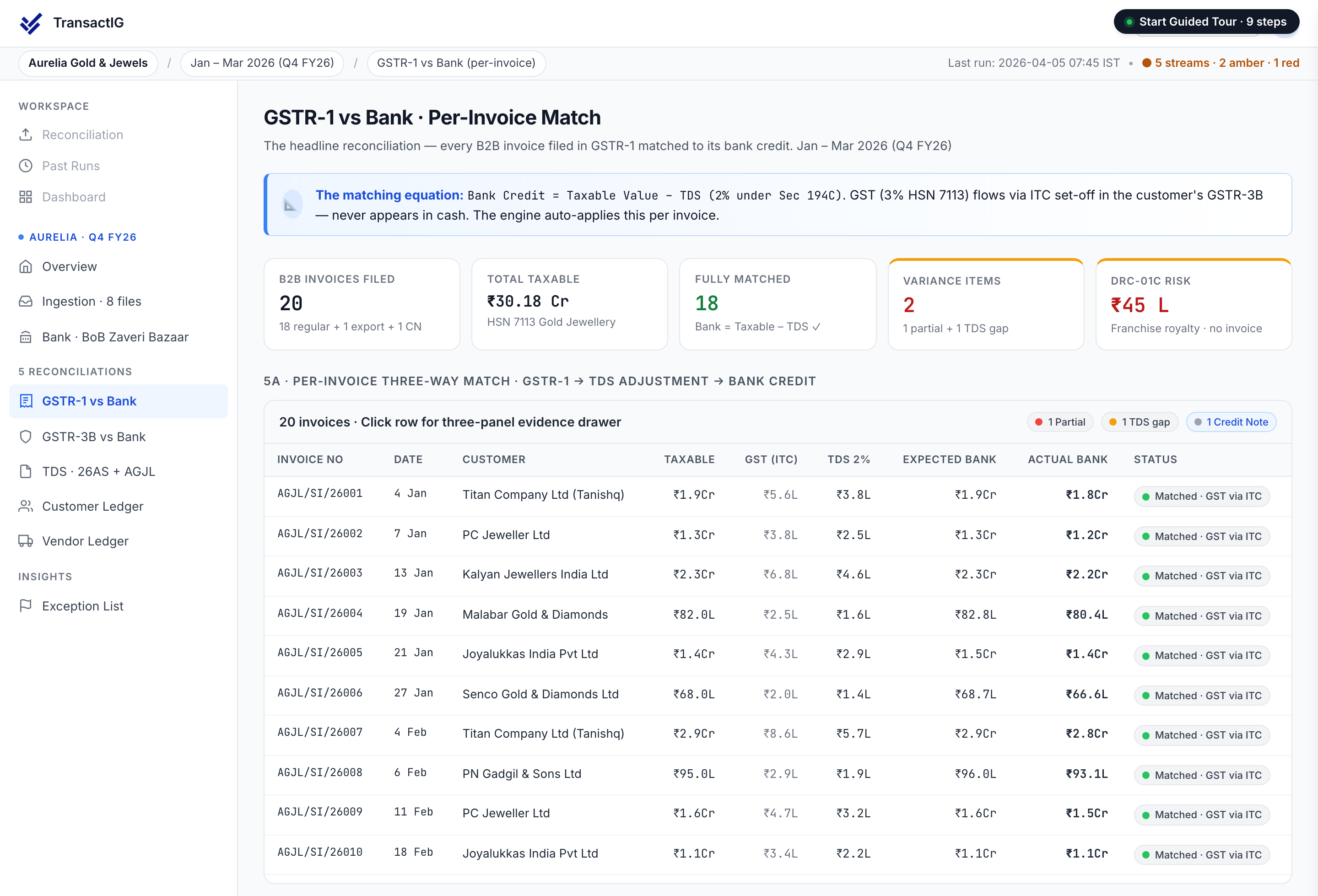
The Invoice with TDS pattern is the most commonly needed reconciliation pattern in Indian business. Every vendor payment arrives net of TDS — the payer deducts tax at source under the applicable section and remits the balance. The payee receives a gross invoice but must match it against the net bank receipt. Without embedded TDS logic, this creates an apparent shortfall on every single transaction. TransactIG's Invoice with TDS pattern pre-computes the expected net amount (gross − TDS at the applicable rate) and matches receipts against that expected value, automatically identifying genuine shortfalls vs TDS-adjusted matches.
Use this pattern when:
- You raise invoices and clients deduct TDS before payment
- You make payments to vendors or contractors and deduct TDS
- You need to reconcile TDS certificates (Form 16A) against your deduction records
- You receive professional fees, rent, commission, or contract payments
- You need to prepare Form 26AS reconciliation before filing ITR
How it works in TransactIG
Ingest invoices and bank data
TransactIG ingests your invoice register (from ERP or Tally) and bank statement. Each invoice record includes the gross amount, TDS section, and TDS rate.
Compute expected net receipt
For each invoice, TransactIG computes the expected net receipt: gross amount minus TDS at the applicable rate. This becomes the matching target for the bank credit.
Match and classify
Bank credits are matched against expected net receipts within a configurable tolerance (typically ₹1 or 0.1%). Unmatched items are classified by variance type: genuine shortfall, excess payment, duplicate, or unknown.
Generate 26AS reconciliation
Matched TDS deductions are recorded against the corresponding TDS certificate reference, enabling 26AS vs books reconciliation before advance tax or ITR filing.
Matching rules
Variance taxonomy
Frequently asked questions
Which TDS sections does this pattern support?
TransactIG covers all major TDS sections: 194C (contractors), 194J (professional/technical services), 194H (commission), 194I (rent), 194A (interest), 194Q (purchase of goods), 194B, and 195 (foreign payments). Rates are maintained in the system and updated with Finance Act amendments.
What if the payer deducts TDS at the wrong rate?
A TDS rate mismatch variance is raised, showing the expected deduction vs actual deduction. This allows you to issue a credit note or follow up with the payer to correct the TDS return.
Can this pattern handle higher-rate TDS deductions (20%) for PAN-not-furnished cases?
Yes. The pattern supports configurable rate overrides for PAN-not-furnished scenarios and maintains a separate variance category for these cases.
See the Invoice with TDS pattern in action
Terra Insight will run a live TransactIG demo using this matching pattern on data from your industry vertical.