Logistics & Transport
Reconciliation for logistics companies, fleet operators, and freight forwarders
Reconciliation in Logistics & Transport
Logistics and transport companies face a uniquely fragmented reconciliation challenge: client billing is on freight invoices with TDS deductions; platform business (Delhivery, Dunzo, Porter, Shiprocket) settles on a weekly cycle with commission pre-deducted; fuel advance accounts are maintained per driver; and subcontractor payments attract TDS under Section 194C. A mid-size logistics operator with 200 vehicles and 3 platform partnerships processes 8,000–20,000 transactions per month across these flows — most of which cannot be reconciled with a standard accounting system.
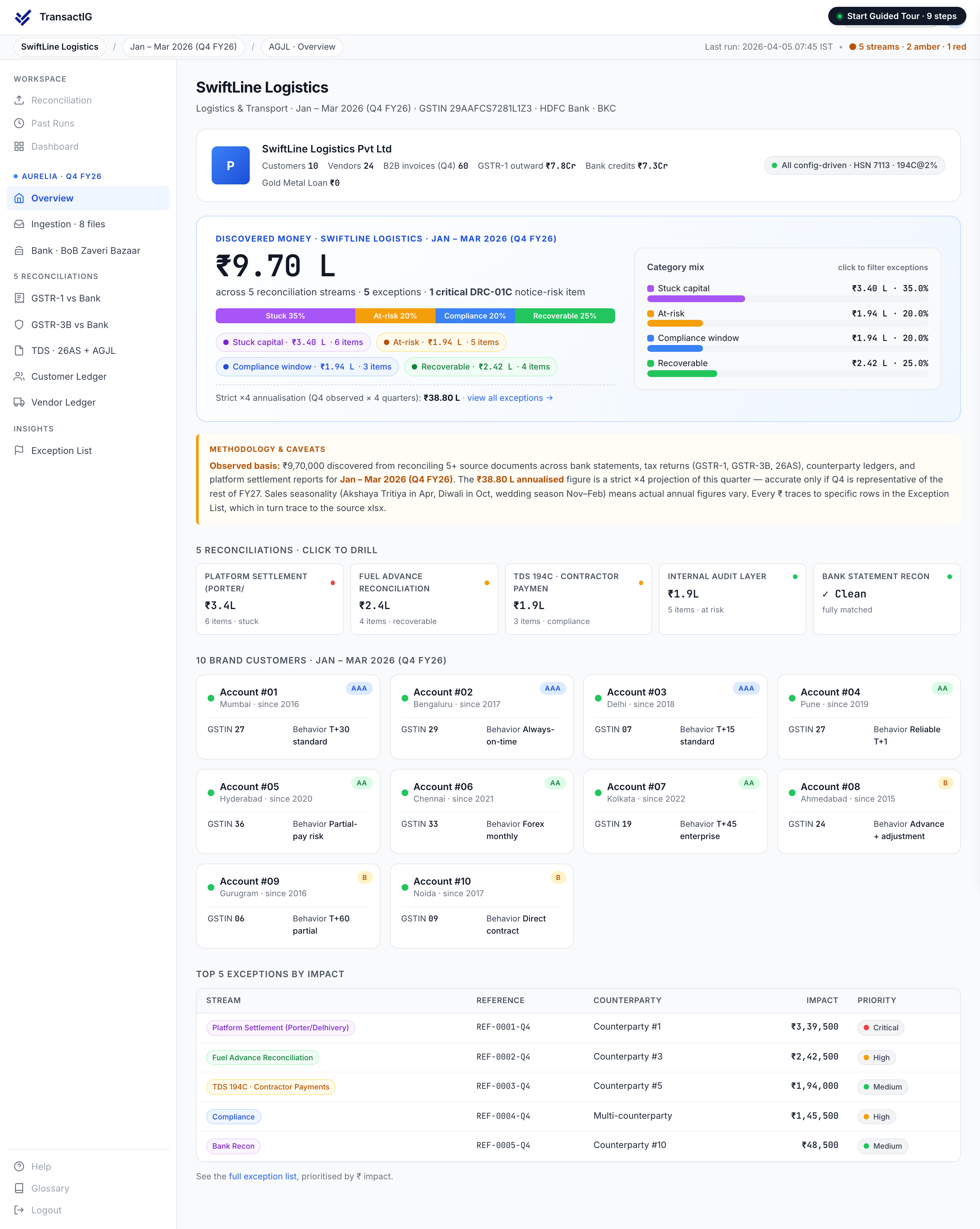
Where reconciliation breaks down
These are the structural problems that generic tools cannot solve for Logistics & Transport businesses.
Platform and aggregator settlement
Delhivery, Dunzo, Porter, and Shiprocket disburse weekly or bi-weekly settlements that aggregate hundreds of delivery completions, with platform fees, returns, and TDS deducted. The settlement files use platform-specific identifiers that do not map to internal trip IDs without a transformation layer.
TDS on freight payments (Section 194C)
Freight payments to transport contractors attract TDS under Section 194C at 2%. Logistics companies both pay TDS (on subcontractor payments) and receive net-of-TDS freight invoices from clients. Both flows must be reconciled separately and reported in TDS returns.
Fuel advance and driver advance accounting
Fuel advances disbursed to drivers create an accounts receivable that is cleared against trip completion records. Without automated reconciliation, fuel advance balances accumulate into a black box that conceals leakage.
Multi-leg freight invoice matching
A single client invoice may cover multiple delivery legs, vehicle changes, or sub-contractor handoffs — each generating its own bank transaction. Reconciling the aggregate invoice against disaggregated credits requires many-to-many matching.
How TransactIG solves this
TransactIG is built by Terra Insight with logistics & transport-specific configuration, not generic matching logic.
Platform settlement disaggregation
Platform settlement reconciliation — ingesting Delhivery, Dunzo, and Porter settlement files and mapping platform trip IDs to internal trip codes against the corresponding freight record — is on the TransactIG roadmap.
Section 194C TDS tracking
TDS on subcontractor freight payments is tracked per vendor, reconciled against Form 26AS, and prepared for quarterly TDS return filing — fully automated.
Fuel advance clearing
The fuel advance matching module reconciles advances against trip completion events and flags uncleared balances per driver — providing a live view of advance exposure.
Reconciliation patterns
Configuration presets
No custom development
These presets are included with every Logistics & Transport deployment of TransactIG. Go live in 2–4 weeks.
Regulatory framework
Logistics & Transport reconciliation in India operates within the following regulatory bodies and compliance frameworks.
Frequently asked questions
Can TransactIG handle settlements from multiple logistics platforms simultaneously?
Multi-platform settlement reconciliation, with platform-specific ingestion templates and unified reporting, is on the TransactIG roadmap.
How does TransactIG match platform trip IDs to our internal trip records?
As part of settlement reconciliation on the TransactIG roadmap, the planned design uses a configurable ID mapping layer: you define the mapping rule once (e.g. platform AWB → internal trip code), and it is applied on every settlement ingestion.
We have 500 drivers with fuel advance accounts. Can TransactIG track each one?
Yes. Fuel advance accounts are tracked per driver record. Advances and clearances are matched by driver ID, with outstanding balances reported at the individual and aggregate level.
How does TransactIG handle return shipments and failed deliveries where the platform claws back the fee?
Returns and clawbacks are classified as a named variance type in the logistics preset, matched against the original delivery credit, and reported separately from genuine settlement shortfalls.
Ready to automate Logistics & Transport reconciliation?
Terra Insight will walk you through a live TransactIG demo using logistics & transport transaction data — matching patterns, variance taxonomy, and ERP integration.