Hotels & Hospitality
Reconciliation for hotels, resorts, and hospitality groups
Reconciliation in Hotels & Hospitality
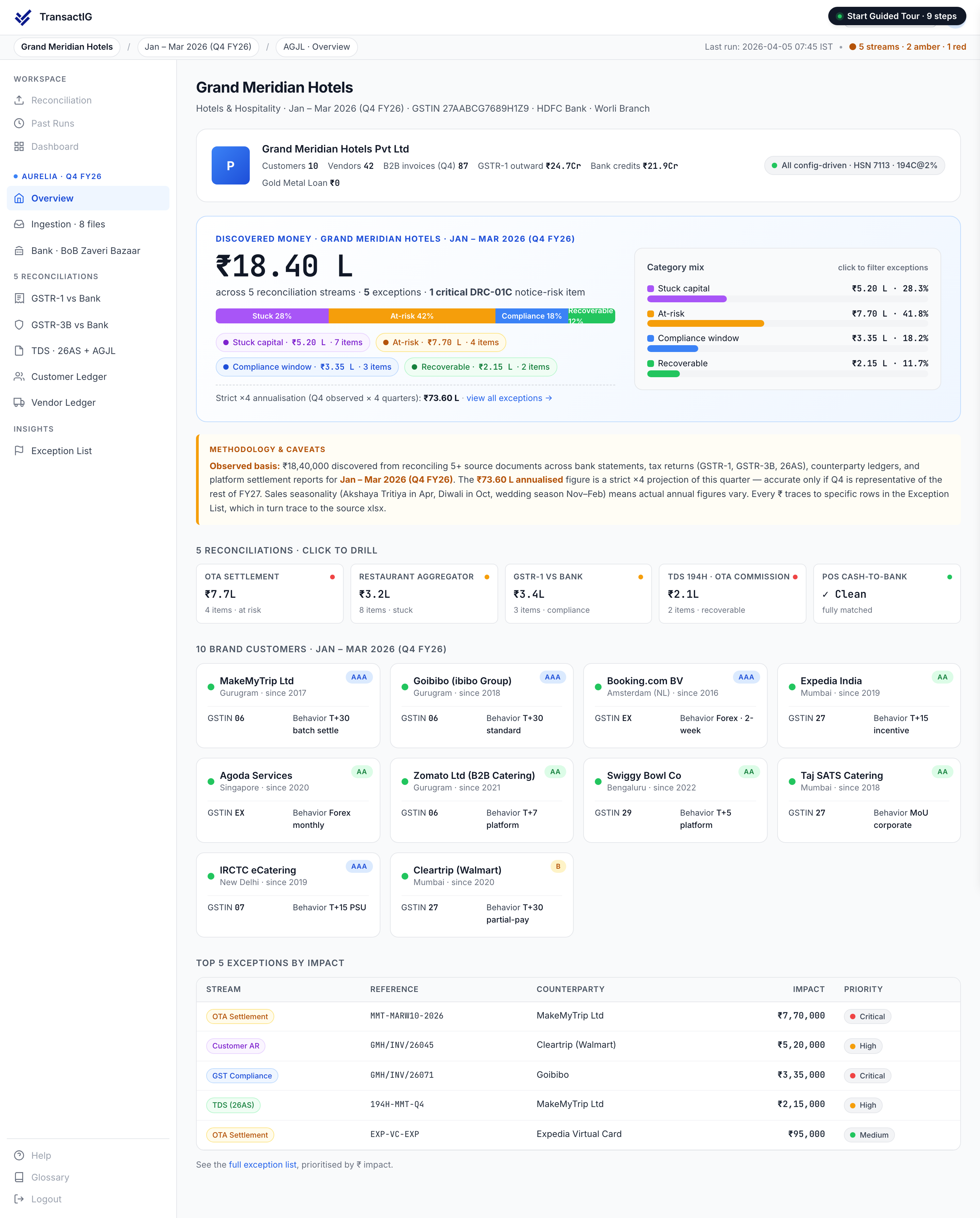
Hotels and hospitality businesses receive revenue through a wider mix of channels than almost any other industry: domestic OTAs (MakeMyTrip, Goibibo, Cleartrip, EaseMyTrip), foreign OTAs (Booking.com, Expedia, Agoda, Airbnb), corporate travel desks, GDS bookings, walk-ins, banquet event sales, restaurant aggregators (Zomato, Swiggy, Magicpin), and direct web bookings — each with its own settlement cycle (3–21 days), commission structure, FX exposure, and tax-deduction profile. Layered on top of this, the post-October-2024 GST regime now splits room tariffs into two slabs: 12% with full ITC for room rates under ₹7,500 per unit per day and 18% with full ITC at ₹7,500 and above, with knock-on effects for in-house F&B (5% no-ITC if the room slab is the lower band, 18% with-ITC if the property is in the upper band). Indian hotels typically lose 2–4% of gross revenue to unreconciled OTA settlement variances — commission disputes, FX timing differences, no-show partial-payouts, virtual-card timing breaks, and disallowed cancellation refunds — that simply never get clawed back because the manual reconciliation effort exceeds the recovery. The complexity compounds for chain hotels operating multiple GSTINs across states, with intercompany transfers, central billing arrangements, and head-office cost allocations that have to tie back to property-level books. Throughout all of this the property management system (Opera, IDS Next, eZee, Hotelogix, Cloudbeds) is the system of record for the folio, but PMS exports rarely line up cleanly with channel-manager (SiteMinder, STAAH, RateGain) feeds, payment-gateway settlements, or the bank statement.
Where reconciliation breaks down
These are the structural problems that generic tools cannot solve for Hotels & Hospitality businesses.
OTA batch settlement lag
MakeMyTrip, Goibibo, and Booking.com disburse payments 7–21 days after checkout in weekly batches. Each disbursement covers hundreds of bookings with OTA commission and TDS deducted. Matching the batch against individual reservation records requires disaggregation logic that most accounting systems cannot perform.
TDS on OTA commission (Section 393, payment code 1007)
OTAs acting as agents deduct TDS on commission before remitting hotel revenue. From April 2026, this TDS is reported under Section 393(1)(f) with payment code 1007 (replacing legacy Section 194H). Reconciling TDS against the new Annual Information Statement and Form 26AS requires matching TDS line items to individual settlements — which OTAs typically batch and report only on annual or quarterly cycles. Cross-era reconciliation (FY2025-26 deductions reported under 194H, FY2026-27 onwards under 393) needs deliberate cutover handling.
Foreign-OTA RCM under Section 9(3) CGST
Commission paid to foreign OTAs (Booking.com BV in the Netherlands, Agoda in Singapore, Airbnb in Ireland) is import of services. The hotel must self-invoice and pay 18% IGST under Reverse Charge per Section 9(3) of the CGST Act, report it in GSTR-3B Table 3.1(d), and claim the corresponding ITC under Section 16 in the same or subsequent month. Missed RCM self-invoices are a recurring audit finding.
Foreign-OTA TDS under Section 413 (replaces Section 195)
Payments to foreign OTAs are subject to TDS on non-resident payments under Section 413 of the Income Tax Act 2025 (the successor to Section 195). The applicable rate depends on the DTAA treaty with the OTA's country of residence and the classification of the payment (commission vs royalty vs FTS). Each remittance needs Form 15CA and, where applicable, Form 15CB certification before the bank will release the wire.
Virtual-card timing breaks
Booking.com, Agoda, and Hotelbeds increasingly settle via virtual credit cards (VCCs) that are charged at check-in rather than at booking. The PMS folio shows revenue at check-out, the gateway settlement file shows the VCC charge date, and the bank statement shows the deposit T+2 days later. Aligning these three timestamps against the original reservation requires cross-period matching logic that most accounting systems cannot perform.
Banquet event advance receipts
Wedding, conference, and banquet bookings collect 25–50% advance months before the event. Under Section 13 of the CGST Act (time of supply for services), GST is due on the advance receipt. At final folio settlement, the advance is reconciled against the actual bill, with adjustment entries for over-collection or scope-creep additions. Tracking advance liability, GST recognition on advance, and reversal at final folio across hundreds of events is a chronic reconciliation problem.
F&B-to-room GST linkage
Inside a single property, GST treatment splits depending on the room tariff slab. A room sold at ₹6,800 attracts 12% GST with ITC; the in-house restaurant on the same property charges 5% with no ITC. A room sold at ₹9,500 attracts 18% GST with ITC, and the restaurant then charges 18% with ITC. Spa, laundry, and minibar each follow their own SAC-code treatment. Mis-classification at PMS level cascades into every downstream return.
Restaurant aggregator reconciliation
Zomato and Swiggy settle weekly with variable commission rates, GST on commission, and TDS. Section 9(5) CGST aggregator liability means the aggregator collects and pays GST on the restaurant supply for orders below the threshold — but the restaurant still needs to reconcile gross order value against net payout against e-commerce TCS reporting. The settlement format changes periodically, requiring regular ingestion template updates.
Multi-property, multi-GSTIN consolidation
Chain hotels operating across states maintain a separate GSTIN per state, with intercompany cross-charges (corporate marketing recharge, central reservations fee, group F&B procurement) flowing between them. Each property's books must reconcile to its own GSTIN return, then roll up to entity-level consolidated financials, with intercompany flows eliminated. Most PMS deployments are property-scoped and have no concept of the entity-level view.
Loyalty program deferred-revenue liability
Loyalty points (Marriott Bonvoy, Taj NeuPass, ITC Club Itc, IHCL Tata NeuPass tie-up) are accrued at booking but redeemed only when the guest later uses points for a stay. Under Ind AS 115, the fair value of points awarded is deferred revenue at the time of the original sale; revenue is recognised on redemption-stay or on breakage (statistical estimation of points that will never be redeemed). Reconciling the points liability ledger to actual redemption stays each month is a complex recurring close item.
Night audit close discipline
Hotels operate a 3-shift PMS roll-over with night audit running between roughly 02:00 and 04:00 to lock the trading day, post room charges, and produce the manager's flash. Late-posted minibar consumption, extended-stay rate adjustments, and split-folio guests routinely create variance categories like MINIBAR_LATE_POST or RATE_OVERRIDE_PENDING that survive into the accounting close two weeks later, by which point the original context is lost.
Multi-channel revenue reconciliation
Property management systems (Opera, IDS Next, eZee, Hotelogix) record reservations at the booked rate. Final settlement amounts differ due to no-shows, early checkouts, channel-specific best-rate-guarantee adjustments, and post-stay refund reversals. Reconciling PMS revenue against bank receipts requires field-by-field matching across systems with tolerance for commission, TDS, GST, and FX.
How TransactIG solves this
TransactIG is built by Terra Insight with hotels & hospitality-specific configuration, not generic matching logic.
OTA settlement disaggregation
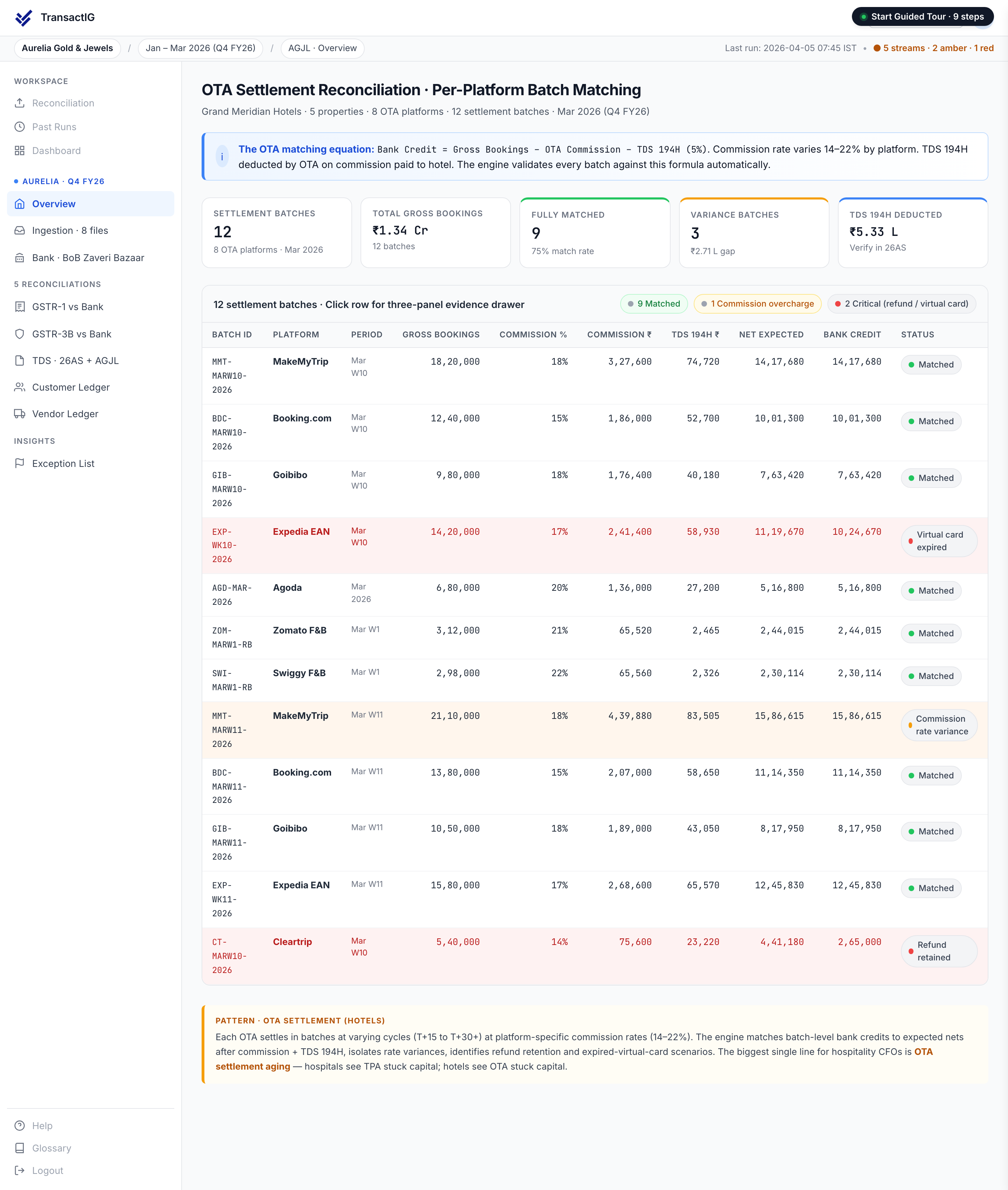
OTA settlement reconciliation — ingesting weekly OTA settlement files and matching each line item to the corresponding booking in your PMS or accounting system, tolerating commission and TDS deductions with pre-configured rates per OTA — is on the TransactIG roadmap.
Section 393 TDS classification
OTA commission TDS (Section 393(1)(f), payment code 1007) is classified separately from room revenue TDS and from foreign-OTA non-resident TDS, enabling accurate Annual Information Statement / Form 26AS reconciliation, TDS-credit tracking by payment code, and clean cross-era handling for FY2025-26 (legacy 194H) → FY2026-27 onwards (393).
Aggregator preset library
Ingestion templates for MakeMyTrip, Goibibo, Booking.com, Expedia, Agoda, Zomato, Swiggy, and Magicpin settlement formats are on the TransactIG roadmap as part of aggregator settlement reconciliation.
Foreign-OTA RCM evidence trail
TransactIG ingests foreign-OTA invoices (Booking.com BV, Agoda Singapore, Airbnb Ireland), and generates the self-invoice metadata required for Section 9(3) RCM. Linking each entry to GSTR-3B Table 3.1(d) for IGST liability sits within GSTR-1 / GSTR-3B outward reconciliation, which leads the TransactIG GST roadmap; linking the matching Section 16 ITC claim is on the roadmap alongside the forthcoming inward-side GST capability.
Section 413 / DTAA-aware non-resident TDS
For payments to foreign OTAs the configuration applies the correct treaty rate from the DTAA master (Netherlands, Singapore, Ireland, US, UAE), classifies the remittance correctly (commission vs royalty vs FTS), and produces Form 15CA/CB-ready output with the supporting ledger references — replacing the spreadsheet-and-courier process most groups still run.
PMS-native ingestion (Opera, IDS Next, eZee, Hotelogix)
Native ingestion templates for the four PMS platforms used by 80%+ of organised Indian hotel inventory, including standard folio export, night-audit close report, and reservation manifest. Field mappings are versioned so PMS upgrades do not silently break the data flow.
Channel-manager parity vs commercial reconciliation
Integration templates for SiteMinder, STAAH, and RateGain feeds let finance reconcile the commercial settlement (what the OTA actually paid) against the channel-manager record (what was sold into the channel), separating distribution-side issues from accounting-side issues.
Virtual-card cross-period matching
Cross-period matching links virtual-card debits to the original booking regardless of which settlement period carries the charge — so a March-booked stay paid in April via a Hotelbeds VCC reconciles cleanly even though the PMS revenue, the VCC charge, and the bank deposit straddle two months.
Banquet advance time-of-supply tracking
Banquet advance receipts are flagged at receipt with Section 13 time-of-supply GST recognition, then reversed and adjusted at final folio settlement — keeping the advance liability ledger and the GST output liability synchronised across the event lifecycle.
Loyalty deferral under Ind AS 115
A points-liability ledger tracks accrual at booking, applies the configured breakage-rate estimate, and recognises revenue on redemption-stay events — giving finance an audit-grade reconciliation of loyalty deferred revenue without the per-property spreadsheet work.
Multi-GSTIN consolidation
Property-level reconciliation rolls up cleanly to entity level today. Auto-matching of cross-entity intercompany flows (corporate marketing recharge, central reservations fee, group procurement) between sister GSTINs, with eliminating entries flagged for the consolidation close, is on the roadmap alongside the forthcoming intercompany reconciliation capability.
Reconciliation patterns
Configuration presets
No custom development
These presets are included with every Hotels & Hospitality deployment of TransactIG. Go live in 2–4 weeks.
Regulatory framework
Hotels & Hospitality reconciliation in India operates within the following regulatory bodies and compliance frameworks.
Frequently asked questions
MakeMyTrip changes their settlement format periodically. How does TransactIG handle that?
OTA settlement-file ingestion is on the TransactIG roadmap. The planned design uses configurable ingestion templates that can be updated via the admin interface, with no code changes required.
Can TransactIG reconcile both hotel and restaurant revenue in the same instance?
Yes. TransactIG supports multi-entity and multi-revenue-stream reconciliation within a single deployment, with separate matching rules per channel.
How does TransactIG handle no-shows where the OTA still disburses a partial amount?
No-show variances are classified as a named variance type in the hospitality preset, distinguishing them from genuine commission deductions and enabling accurate revenue recognition.
We operate 12 properties under one legal entity. Can TransactIG handle multi-property reconciliation?
Yes. TransactIG supports property-level segmentation with separate clearing accounts per property, consolidated under the single legal entity for tax reporting.
How does TransactIG handle the cross-era TDS shift from Section 194H to Section 393 for OTA commission?
TransactIG carries a rate-by-date table per payment code. Settlements with deduction dates on or before 31 March 2026 are matched and reported under legacy Section 194H; deductions on or after 1 April 2026 are matched under Section 393(1)(f) with payment code 1007. The distinction is preserved through to AIS / 26AS reconciliation so cross-era credits stay traceable.
What does the foreign-OTA RCM workflow under Section 9(3) actually look like?
Foreign-OTA invoices (Booking.com BV, Agoda Singapore, Airbnb Ireland) are ingested and tagged as import of services. TransactIG generates the self-invoice metadata. Linking the IGST liability to GSTR-3B Table 3.1(d) for the month of receipt sits within GSTR-1 / GSTR-3B outward reconciliation, which leads the TransactIG GST roadmap; linking the matching Section 16 ITC claim is on the roadmap alongside the forthcoming inward-side GST capability.
How are virtual-card payments from Booking.com or Hotelbeds reconciled when the charge date and folio date are in different months?
Cross-period matching links the virtual-card debit to the original booking and folio regardless of which calendar month the charge falls in. The PMS folio close, the gateway VCC settlement, and the bank deposit are matched as a triple, with the period-spanning variance classified separately so revenue recognition stays aligned with Ind AS 115.
How is night-audit close handled when minibar charges or rate overrides post late?
TransactIG's hospitality preset distinguishes the system close (PMS night audit completion) from the accounting close. Late-posted items such as MINIBAR_LATE_POST or RATE_OVERRIDE_PENDING are surfaced as named variance types against the original trading day, with an automatic adjustment trail so the accounting period can close cleanly even when the operational late-post arrives days later.
Ready to automate Hotels & Hospitality reconciliation?
Terra Insight will walk you through a live TransactIG demo using hotels & hospitality transaction data — matching patterns, variance taxonomy, and ERP integration.