Staffing & Manpower
Reconciliation for staffing agencies, contract manpower providers, and payroll outsourcers
Reconciliation in Staffing & Manpower
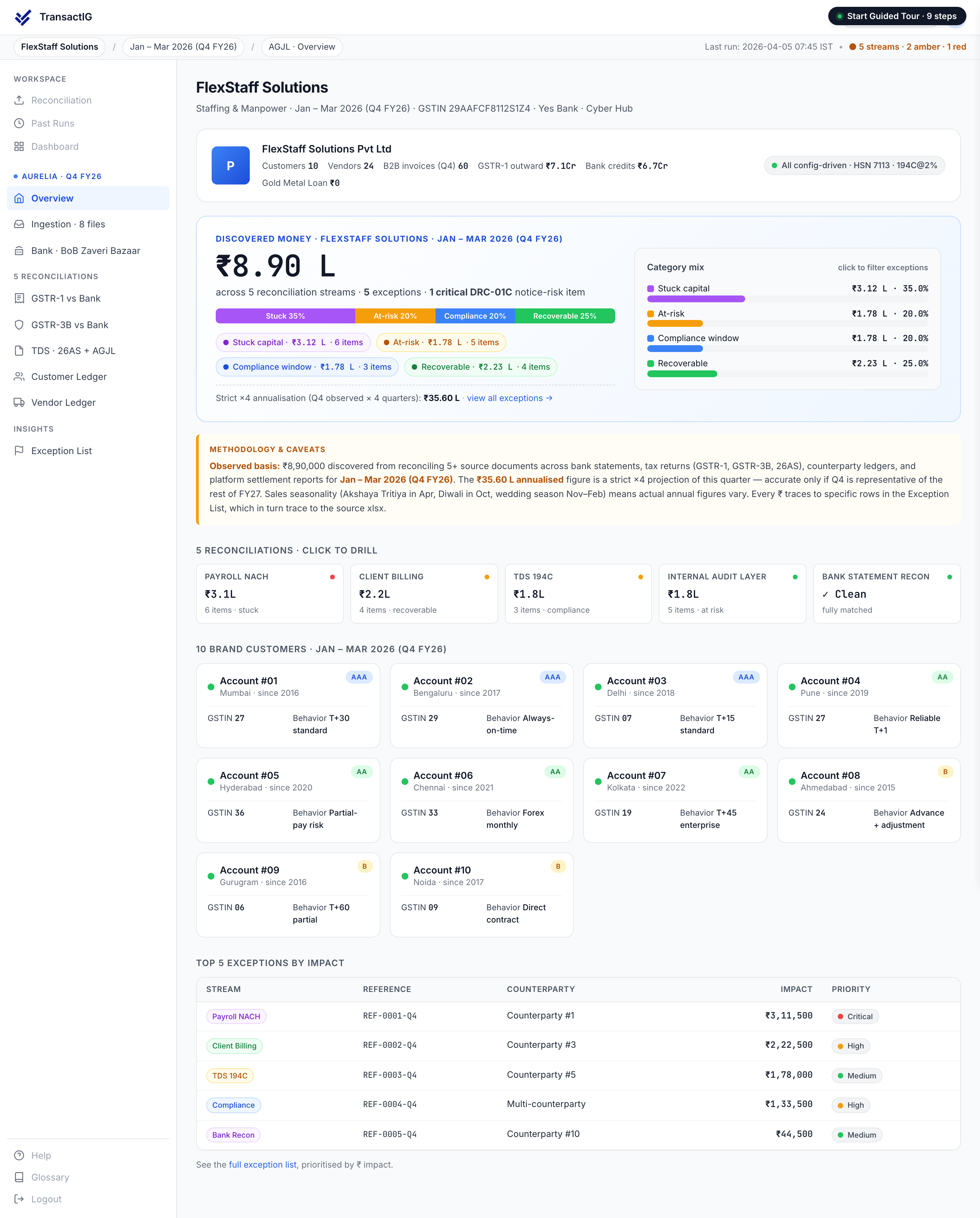
Staffing and contract manpower businesses sit between two complex financial flows: billing clients for deployed headcount (typically on a cost-plus or fixed-rate model with TDS under Section 194C), and disbursing payroll to contractual staff with mandatory PF, ESI, and professional tax deductions. A mid-size staffing firm deploying 2,000 contractual workers across 50 client sites processes 24,000 monthly payroll transactions, 600+ monthly client invoices, and 2,400+ monthly PF/ESI challans — all of which must reconcile against each other and against client bank receipts.
Where reconciliation breaks down
These are the structural problems that generic tools cannot solve for Staffing & Manpower businesses.
Client billing vs payroll mismatch
Client invoices are raised on the deployed headcount as of billing date; payroll is processed at month-end after attendance reconciliation. Joinings, exits, and absenteeism during the month create a gap between billed headcount and actual payroll — a variance that must be tracked per client site.
TDS on manpower contracts (Section 194C)
Clients deduct TDS at 2% (1% for individuals/HUF) on manpower contract payments under Section 194C. Reconciling net receipts against gross invoices, and tracking TDS credit across 50+ clients, requires systematic per-client TDS tracking that manual processes cannot scale.
PF and ESI contribution reconciliation
Monthly PF (12% employer + 12% employee) and ESI (3.25% employer + 0.75% employee) contributions must be computed per employee, deposited by the 15th of the following month, and reconciled against EPFO and ESIC challans. Errors in contribution mapping create compliance exposure.
Multi-site attendance and billing accuracy
Staffing firms operate across dozens of client sites, each with different shift patterns, overtime rates, and skill categories. Billing accuracy depends on site-level attendance data that arrives with delays and is frequently disputed by clients.
How TransactIG solves this
TransactIG is built by Terra Insight with staffing & manpower-specific configuration, not generic matching logic.
Client billing vs payroll clearing
TransactIG reconciles billed headcount against payroll records per client site, identifying billing gaps from joinings, exits, and absenteeism — enabling accurate credit/debit note issuance.
Section 194C TDS tracking
TDS deductions across all clients are tracked automatically, reconciled against bank receipts, and prepared for quarterly TDS return filing — with per-client TDS credit reports for 26AS matching.
PF and ESI challan reconciliation
Contribution amounts per employee are matched against EPFO/ESIC challans, with shortfall and excess amounts flagged before the deposit deadline.
Reconciliation patterns
Configuration presets
No custom development
These presets are included with every Staffing & Manpower deployment of TransactIG. Go live in 2–4 weeks.
Regulatory framework
Staffing & Manpower reconciliation in India operates within the following regulatory bodies and compliance frameworks.
Frequently asked questions
We bill clients on the 1st and process payroll on the 25th. How does TransactIG handle the timing gap?
TransactIG matches billing records to payroll on a configurable cut-off date basis. Joinings and exits that fall between the billing date and payroll date are treated as a named variance type and reported separately for credit/debit note processing.
Can TransactIG track TDS certificates received from 50+ clients for 26AS reconciliation?
Yes. TransactIG maintains a per-client TDS register that tracks deductions by quarter, matches against Form 16A certificates, and produces a 26AS reconciliation report for the CA.
How does TransactIG handle variable components like overtime and attendance incentives?
Variable pay components are configured as named payroll fields. Billing rules can incorporate variable components, with the actual vs billed variance computed per employee per site.
Can TransactIG handle both permanent and contractual employee payroll in the same instance?
Yes. TransactIG supports multiple employee categories with different statutory contribution rules, billing rates, and TDS treatment — all within a single deployment.
Ready to automate Staffing & Manpower reconciliation?
Terra Insight will walk you through a live TransactIG demo using staffing & manpower transaction data — matching patterns, variance taxonomy, and ERP integration.