Insurance
Reconciliation for insurance companies, brokers, and TPAs
Reconciliation in Insurance
Insurance companies in India manage three distinct financial flows simultaneously: premium collection (through agents, brokers, banks, and digital channels); claims disbursement (to policyholders via NEFT, cheque, or TPA network); and reinsurance settlement (cedant premium vs reinsurer recovery on proportional and non-proportional treaties). Each flow has regulatory reconciliation requirements under IRDAI guidelines, including the need to maintain policyholder funds separately from shareholder funds. A mid-size general insurer processing 200,000 policies per year handles 12–15 million premium collection events, 80,000–150,000 claim transactions, and complex quarterly reinsurance settlements with 10–20 reinsurance counterparties.
Where reconciliation breaks down
These are the structural problems that generic tools cannot solve for Insurance businesses.
Premium collection channel reconciliation
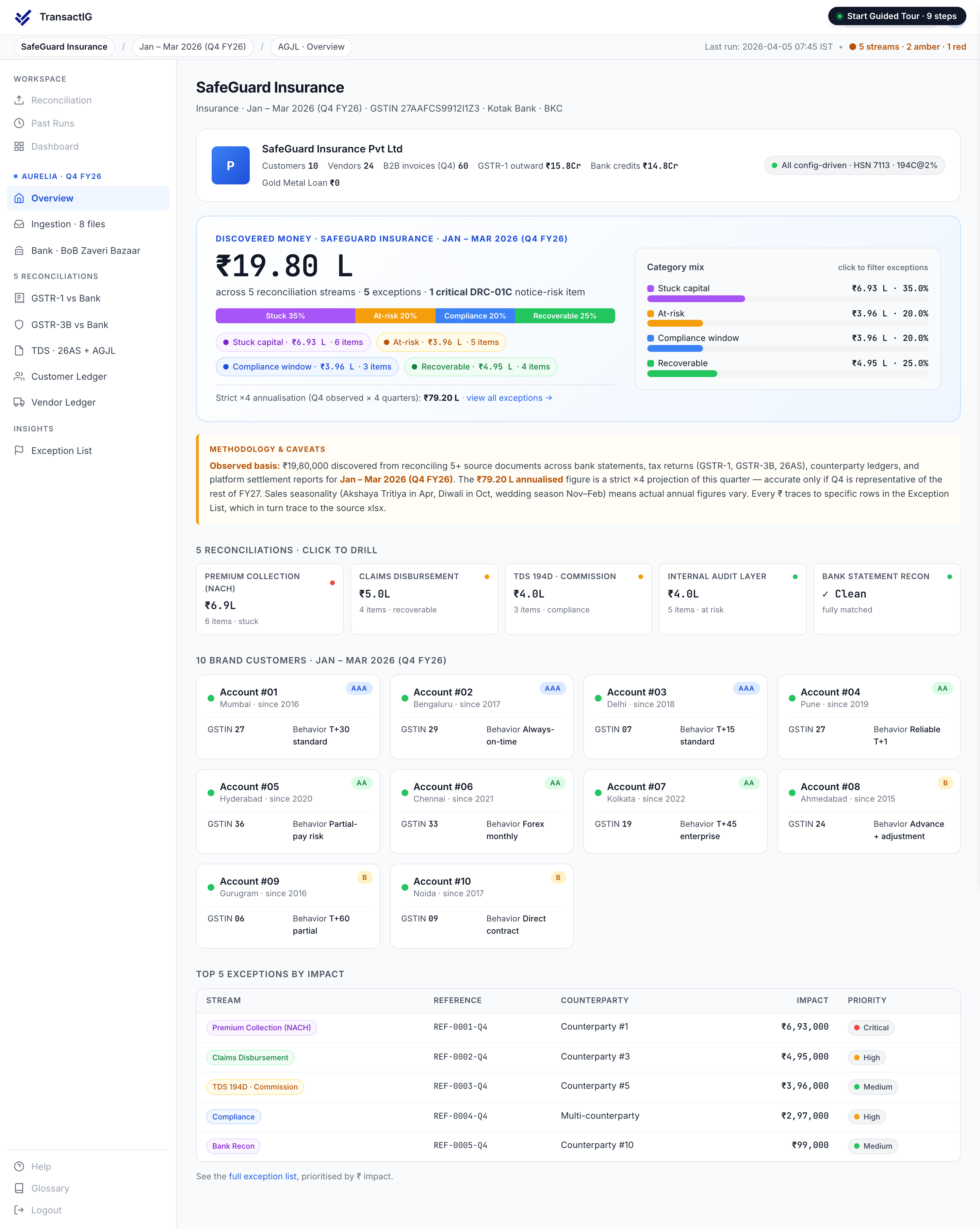
Premiums are collected through agents, direct debit (NACH), web portal, mobile apps, banks (bancassurance), and payment aggregators. Each channel remits on a different cycle with different charges deducted. Reconciling total premiums in force against actual collections — per channel, per product, per period — is a daily compliance obligation.
Claims disbursement reconciliation
Claims are disbursed via NEFT, RTGS, cheque, and TPA network. The disbursement record must match the settlement advice from the claims system, with stale cheques, returned NEFT credits, and TPA reimbursements tracked separately.
Reinsurance settlement reconciliation
Proportional treaty settlements involve sharing premium and claims with reinsurers on a quarterly basis. Bordereaux (schedule of ceded risks) must be reconciled against reinsurer accounts, with exchange rate differences, profit commission, and loss corridors computed accurately.
TDS on maturity and surrender (Section 194DA)
Life insurance companies deduct TDS at 5% under Section 194DA on maturity proceeds where the sum assured is less than 10 times the annual premium. Reconciling TDS deducted against Form 26AS filings and policyholder TDS certificates is a mandatory compliance process.
How TransactIG solves this
TransactIG is built by Terra Insight with insurance-specific configuration, not generic matching logic.
Premium collection channel matching
TransactIG reconciles agent remittances on the bank statement against premium records in the insurance administration system — per policy, per channel, per period. NACH batch and payment gateway settlement reconciliation are on the roadmap.
Claims disbursement matching
NEFT and RTGS credit confirmations are matched against claims settlement advices, with returned credits, stale cheques, and TPA reimbursements classified as named variance types.
Reinsurance bordereaux reconciliation
The multi-invoice aggregation pattern handles quarterly reinsurance settlement matching — reconciling ceded premium, recoverable claims, and profit commission against the reinsurer account statement.
Reconciliation patterns
Configuration presets
No custom development
These presets are included with every Insurance deployment of TransactIG. Go live in 2–4 weeks.
Regulatory framework
Insurance reconciliation in India operates within the following regulatory bodies and compliance frameworks.
Frequently asked questions
How does TransactIG handle a NACH batch where some mandates return unpaid?
NACH presentation and return matching is on the TransactIG roadmap. In the planned design, NACH returns are matched to the original mandate and classified as unpaid, with follow-up queued for the renewal team.
Can TransactIG handle both life and general insurance in the same instance?
Yes. TransactIG supports multi-product-line reconciliation with separate matching rules for life and general insurance flows, and consolidated reporting for the company.
How does TransactIG handle returned NEFT credits where the claims payment has failed?
Returned NEFT credits are matched against the original claims disbursement record, flagged as returned with the bank rejection reason code, and queued for re-initiation.
Does TransactIG support IRDAI regulatory reporting requirements?
TransactIG's reconciliation outputs are structured to support IRDAI quarterly returns, with policyholder fund and shareholder fund segregation visible at the reconciliation level.
Ready to automate Insurance reconciliation?
Terra Insight will walk you through a live TransactIG demo using insurance transaction data — matching patterns, variance taxonomy, and ERP integration.