Telecom
Reconciliation for telecom operators, ISPs, and telecom infrastructure companies
Reconciliation in Telecom
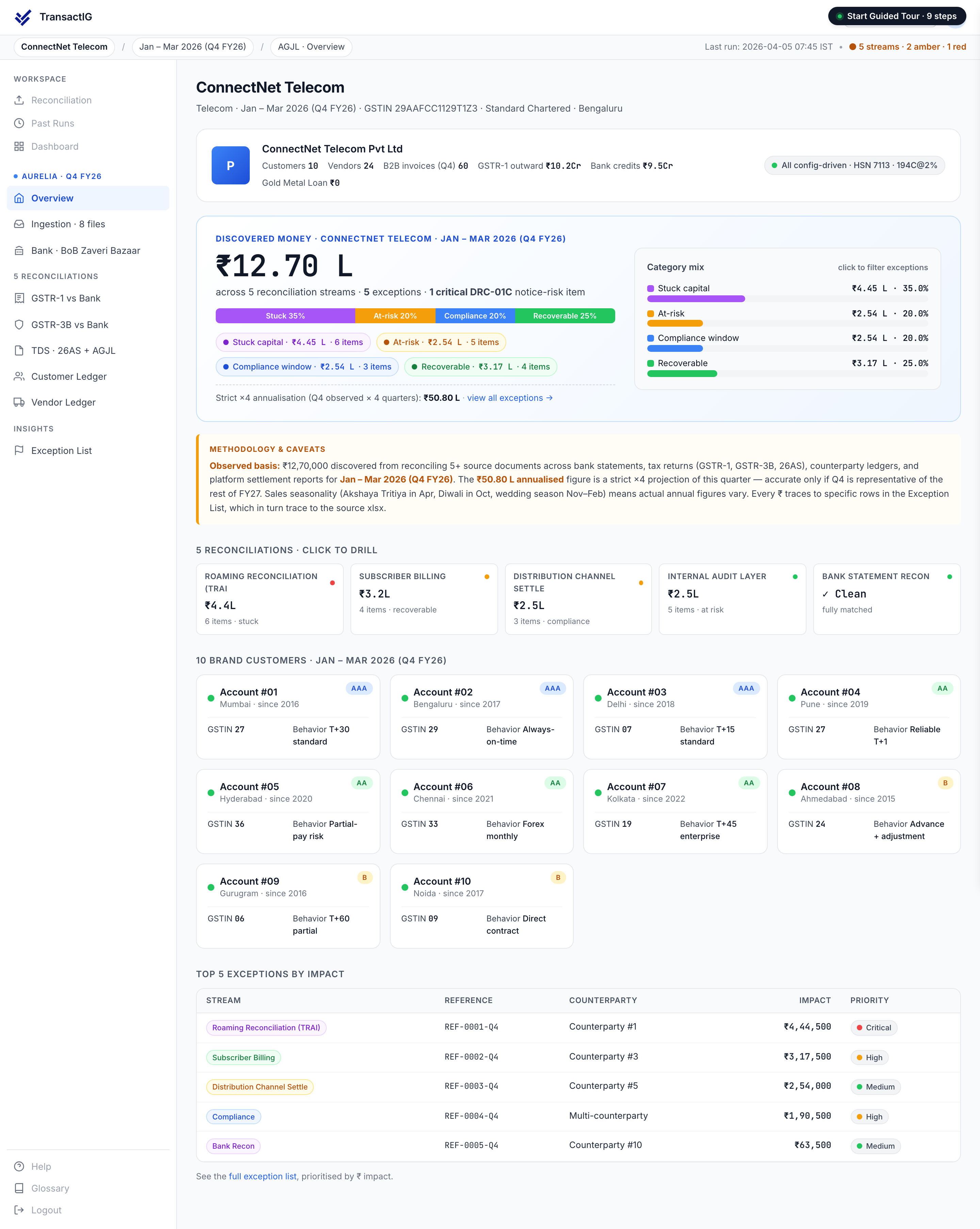
Telecom operators and ISPs manage multi-layered financial flows: bilateral roaming and interconnect settlement with domestic and international operators; subscriber billing and collection through prepaid recharges, postpaid cycles, and enterprise contracts; dealer commission payouts under Section 194H; and infrastructure sharing (tower rental, dark fibre IRU) with periodic true-up settlements. Enterprise telecom customers bill on account with credit terms, while mass-market billing runs daily. A mid-size ISP with 100,000 subscribers processes 1.5–3 million revenue events per month across recharge, monthly billing, and enterprise invoicing.
Where reconciliation breaks down
These are the structural problems that generic tools cannot solve for Telecom businesses.
Interconnect and roaming settlement
Bilateral roaming settlement with other operators involves call detail records (CDRs) that must be matched between originating and terminating networks. Disputed CDRs, rate card differences, and settlement timing mismatches create a reconciliation burden that grows with traffic volume.
Subscriber billing vs collection gap
Postpaid billing generates invoices that are collected 30–45 days later via NACH, UPI, or over-the-counter. The gap between billing and collection — combined with partial payments, disputed bills, and bad debt — creates an accounts receivable reconciliation challenge at scale.
Dealer commission reconciliation (Section 194H)
Dealer and distributor commissions on prepaid recharge sales attract TDS under Section 194H. Reconciling commissions earned against recharge volumes, deducting TDS, and tracking the netted payment to each dealer requires transaction-level commission computation.
Infrastructure sharing true-up
Tower rental and dark fibre IRU agreements have periodic true-up clauses based on actual usage vs contracted capacity. Reconciling usage-based adjustments against the base rental invoice — and agreeing true-up amounts with counterparties — requires multi-period matching logic.
How TransactIG solves this
TransactIG is built by Terra Insight with telecom-specific configuration, not generic matching logic.
CDR-based roaming settlement matching
TransactIG ingests CDR files from both legs of bilateral roaming and matches usage records by timestamp, MSISDN, and routing code — classifying disputed records for escalation.
Section 194H dealer commission tracking
Dealer commissions are computed from recharge sales data, TDS deducted at source, and net payments reconciled against bank credits — with per-dealer TDS registers for quarterly filing.
Infrastructure sharing reconciliation
Base rental and true-up components are tracked separately per site. True-up amounts are reconciled against usage data and matched against the periodic debit/credit note.
Reconciliation patterns
Configuration presets
No custom development
These presets are included with every Telecom deployment of TransactIG. Go live in 2–4 weeks.
Frequently asked questions
Can TransactIG handle TAP/RAP file formats for international roaming settlement?
Yes. TransactIG supports TAP (Transferred Account Procedure) and RAP (Return Accounts Procedure) file ingestion for bilateral international roaming settlement.
We have 500 dealers across 15 states. Can TransactIG track TDS per dealer?
Yes. Dealer commissions and TDS are tracked per dealer with state-wise segmentation. Quarterly TDS return data is available per dealer for Form 26Q filing.
How does TransactIG handle disputed CDRs in interconnect settlement?
Disputed CDRs are classified as a named variance type with the disputing party, amount, and period flagged. The reconciliation report tracks disputed amounts separately from accepted settlement.
Can TransactIG reconcile NACH-based postpaid collections against the billing cycle?
NACH batch reconciliation is on the TransactIG roadmap. In the planned design, NACH batch credits are disaggregated by subscriber account and matched against outstanding postpaid invoices, with bounces and partial payments tracked per account.
Ready to automate Telecom reconciliation?
Terra Insight will walk you through a live TransactIG demo using telecom transaction data — matching patterns, variance taxonomy, and ERP integration.