Retail & E-Commerce
Reconciliation for online retailers, D2C brands, and marketplace sellers
Reconciliation in Retail & E-Commerce
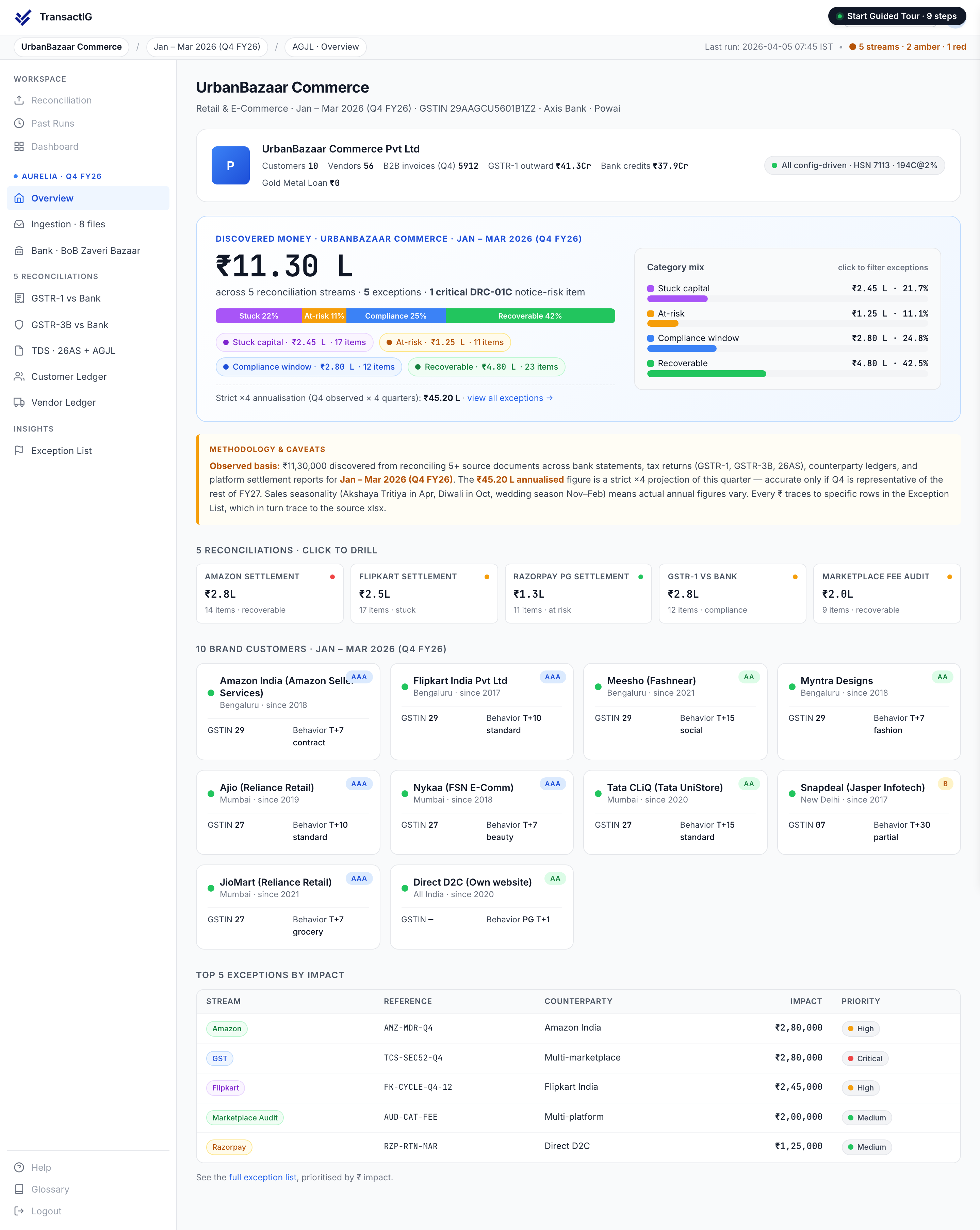
Indian e-commerce sellers operate across Amazon, Flipkart, Meesho, Myntra, and their own D2C channels simultaneously. Each marketplace settles on a different cycle (Amazon: 7–14 days; Flipkart: 7 days; Meesho: 7 days), with commissions, referral fees, returns, and TDS under Section 194O pre-deducted. A seller with ₹5 Cr monthly GMV across three platforms processes 10,000–50,000 order-level transactions per month, each of which must be matched to its settlement line, GST liability, and inventory record. Without automated reconciliation, marketplace fee disputes, unreconciled returns, and GST mismatches become chronic.
Where reconciliation breaks down
These are the structural problems that generic tools cannot solve for Retail & E-Commerce businesses.
Marketplace settlement complexity
Amazon, Flipkart, and Meesho settlements include order credits, commission debits, return adjustments, advertising charges, and storage fees in a single file. Reconciling the net settlement to individual order records requires multi-line disaggregation that no standard accounting package performs.
TDS under Section 194O
E-commerce operators deduct TDS at 1% on gross sales under Section 194O before remitting to sellers. Reconciling TDS deductions against Form 26AS and tracking per-marketplace TDS credit requires embedded tax logic across settlement files.
Return and refund accounting
Customer returns generate credit notes or settlement deductions that must be matched back to the original order, with the corresponding GST reversal. High return categories (apparel, electronics) create a perpetual reconciliation lag.
GST on marketplace fees
Commissions, fulfillment fees, and advertising charges attract GST that is recoverable as ITC. Reconciling GST on marketplace charges against GSTR-2A/2B — and matching against actual deductions in settlement files — is a monthly compliance burden.
How TransactIG solves this
TransactIG is built by Terra Insight with retail & e-commerce-specific configuration, not generic matching logic.
Marketplace settlement disaggregation
TransactIG ingests Amazon, Flipkart, and Meesho settlement files and reconciles each line — order credits, commissions, returns, ad charges — against your order management system, producing a matched ledger per marketplace.
Section 194O TDS tracking
TDS deductions are extracted from each settlement, tracked per marketplace, and matched against Form 26AS for accurate TDS credit accounting.
Return reconciliation
Return deductions in settlement files are matched to the original order record, with GST reversal amounts computed and posted to the GST return workbook.
Reconciliation patterns
Configuration presets
No custom development
These presets are included with every Retail & E-Commerce deployment of TransactIG. Go live in 2–4 weeks.
Regulatory framework
Retail & E-Commerce reconciliation in India operates within the following regulatory bodies and compliance frameworks.
Frequently asked questions
Can TransactIG reconcile settlements from multiple marketplaces simultaneously?
Yes. TransactIG processes Amazon, Flipkart, Meesho, and other marketplace settlements in the same reconciliation run, with platform-specific ingestion templates and unified reporting.
How does TransactIG handle marketplace settlement format changes?
Ingestion templates can be updated via the admin interface without code changes. Amazon and Flipkart format updates are typically applied within 2 business days.
We sell on our own website in addition to marketplaces. Can TransactIG handle both?
Yes. D2C payment gateway settlements (Razorpay, Cashfree) and marketplace settlements are processed in the same instance, with separate matching rules per channel.
How are high-return categories like apparel handled differently?
Return tolerance thresholds are configurable per product category. High-return categories can be assigned wider matching tolerances, with returns classified by reason code from the marketplace settlement file.
Ready to automate Retail & E-Commerce reconciliation?
Terra Insight will walk you through a live TransactIG demo using retail & e-commerce transaction data — matching patterns, variance taxonomy, and ERP integration.