Real Estate
Reconciliation for developers, builders, and real estate businesses
Reconciliation in Real Estate
Real estate developers manage two major financial flows simultaneously: inflow from buyers (instalment-based, milestone-linked, or demand-based across a 2–7 year project lifecycle) and outflow to contractors (civil, MEP, interior, and landscaping with retention holdbacks and milestone billing). TDS under Section 194IA must be deducted by buyers on property consideration above ₹50 lakh. TDS under Section 194C applies on construction contracts. A developer with 500 units under construction manages 3,000+ buyer instalments per quarter and 200+ contractor invoices per month — all of which must reconcile against project accounts and RERA compliance requirements.
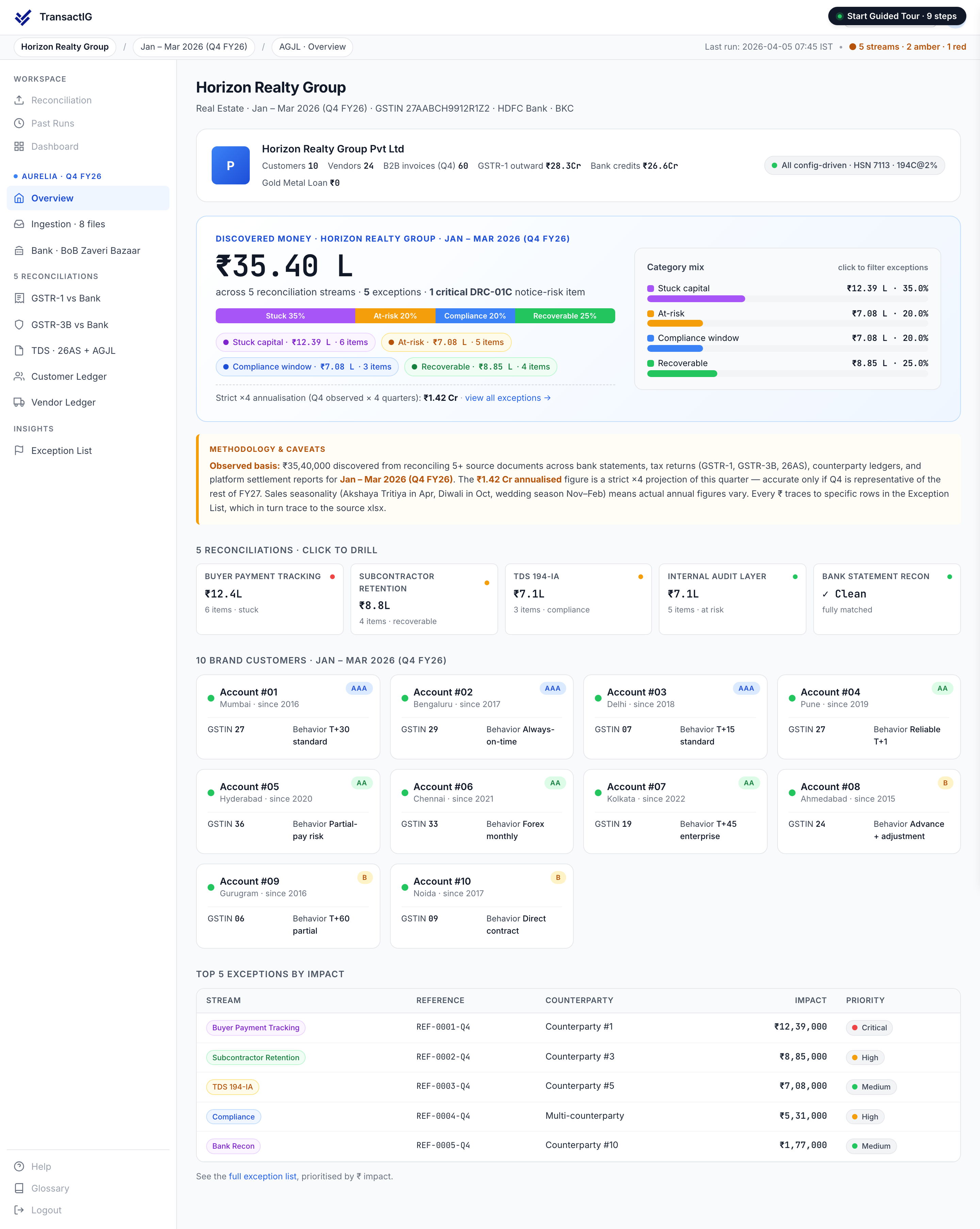
Where reconciliation breaks down
These are the structural problems that generic tools cannot solve for Real Estate businesses.
Buyer payment schedule tracking
Construction-linked and time-linked payment plans generate demand notices at specific milestones. Buyers pay on different schedules, partially, or with home loan disbursements that arrive directly from banks. Reconciling actual receipts against the demand schedule — per unit, per buyer — requires a structured tracking layer that standard accounting does not provide.
TDS under Section 194IA
Buyers must deduct TDS at 1% on property consideration above ₹50 lakh and deposit via Form 26QB. Developers must reconcile TDS credit from Form 26AS against buyer payment records — and follow up with buyers who have not deposited. The RERA audit requirement makes this reconciliation mandatory.
Subcontractor retention and release
Civil and fit-out contracts typically hold back 5–10% of each running account bill until completion and defect-liability expiry. Tracking retention per contractor, per contract stage, and releasing on schedule — without double payment — requires a retention ledger that most builders manage in spreadsheets.
RERA escrow account compliance
RERA requires 70% of buyer collections to be deposited in a dedicated escrow account. Reconciling escrow deposits against buyer receipts — and tracking withdrawals against construction invoices — is a compliance obligation with significant penalty exposure.
How TransactIG solves this
TransactIG is built by Terra Insight with real estate-specific configuration, not generic matching logic.
Buyer payment schedule matching
TransactIG matches each bank receipt against the outstanding demand notice for the corresponding unit and buyer, tracking partial payments, home loan disbursements, and payment plan deviations per unit.
Section 194IA TDS tracking
TDS deducted by buyers is tracked per unit, reconciled against Form 26AS, and flagged for follow-up when 26QB filings are missing — giving developers a complete TDS credit register for each project.
Contractor retention management
The retention money pattern tracks holdbacks per contractor and contract stage, computes release schedules based on completion milestones, and prevents double payment during final account settlement.
Reconciliation patterns
Configuration presets
No custom development
These presets are included with every Real Estate deployment of TransactIG. Go live in 2–4 weeks.
Regulatory framework
Real Estate reconciliation in India operates within the following regulatory bodies and compliance frameworks.
Frequently asked questions
How does TransactIG handle a buyer who pays in parts across a single demand notice?
Partial payments are matched against the open demand balance, with the residual tracked as outstanding. Home loan partial disbursements and buyer own-fund splits are supported.
Can TransactIG track RERA escrow deposits and verify the 70% compliance threshold?
Yes. TransactIG reconciles buyer receipts against escrow deposits, computes the required deposit amount per collection, and flags shortfalls for compliance review.
We have 3 projects under different SPVs. Can TransactIG handle multi-entity reconciliation?
Yes. TransactIG supports multi-entity deployments with separate reconciliation instances per legal entity and consolidated reporting across all projects.
How does TransactIG handle TDS in a situation where the buyer has not filed Form 26QB?
TransactIG tracks the expected TDS credit per unit and flags units where 26AS credit has not appeared after a configurable number of days — enabling the developer to follow up with the buyer before the filing deadline passes.
Ready to automate Real Estate reconciliation?
Terra Insight will walk you through a live TransactIG demo using real estate transaction data — matching patterns, variance taxonomy, and ERP integration.