Media & Publishing
Reconciliation for media companies, publishers, and digital content businesses
Reconciliation in Media & Publishing
Media and publishing businesses in India earn through a combination of advertising (Google AdSense, Meta Ads, programmatic networks), subscription platforms (Apple, Google, Spotify, Amazon), content licensing (OTT platforms, syndication), and print/event revenue. Each revenue stream has a different settlement cycle, currency, and commission structure. Digital advertising revenue is typically settled monthly in USD; subscription platforms remit quarterly; content licensing fees arrive against specific agreements. A digital media business with ₹20 Cr annual revenue reconciles 8–12 different revenue sources per month — each with its own settlement file, TDS deduction, and GST treatment.
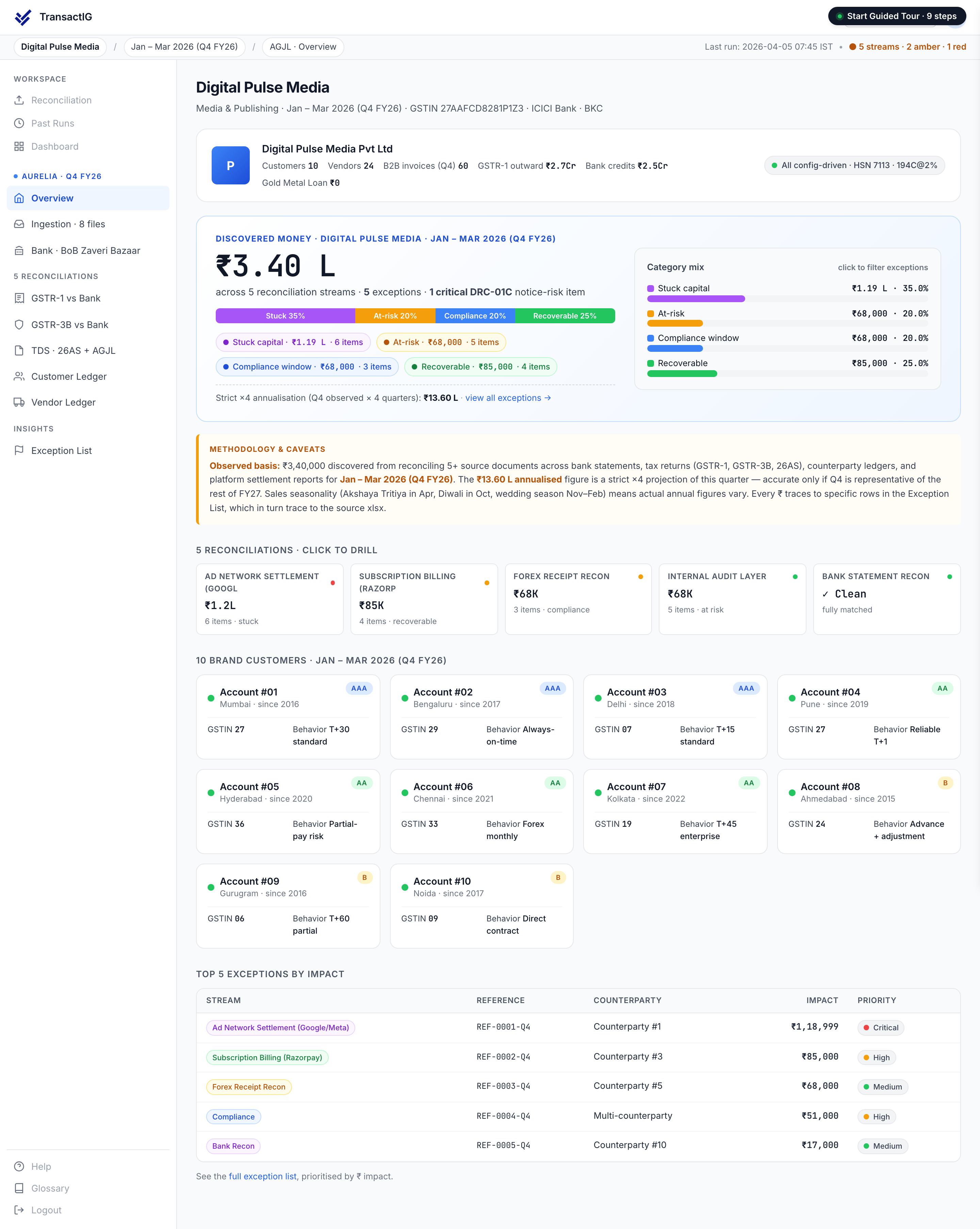
Where reconciliation breaks down
These are the structural problems that generic tools cannot solve for Media & Publishing businesses.
Ad network revenue reconciliation
Google AdSense, Meta, and programmatic networks report estimated earnings that differ from final settled amounts due to invalid traffic adjustments, publisher network fees, and currency conversion. Reconciling final USD settlements against INR earnings reports — and matching against bank credits — requires forex-aware matching.
Subscription platform royalty reconciliation
Spotify, Apple Music, Google Play, and Amazon Kindle pay royalties quarterly with complex per-stream or per-unit rates applied to usage data. The royalty statement rarely maps directly to invoiced amounts, and TDS is deducted in India on domestic platform payouts.
TDS on content licensing and royalties
OTT platforms and content aggregators deduct TDS under Section 194J (technical/professional services) or Section 194C on content licensing fees. Reconciling net receipts against licence fee invoices and tracking TDS across 6–10 platforms requires systematic tracking.
GST on digital advertising services
Indian publishers receiving advertising revenue from foreign ad networks must pay GST on reverse-charge basis (Section 9(3)) on the import of services. Reconciling reverse-charge GST liability against ad network settlements — and claiming the corresponding ITC — requires cross-referencing bank receipts with GST workbooks.
How TransactIG solves this
TransactIG is built by Terra Insight with media & publishing-specific configuration, not generic matching logic.
Ad network settlement reconciliation
TransactIG ingests Google AdSense, Meta, and programmatic network settlement files, converts USD amounts at the transaction exchange rate, and matches against INR bank credits — isolating forex variance as a named category.
Content platform royalty matching
Royalty statements from OTT and streaming platforms are matched against licence agreements and invoices, with per-title variance classified and tracked for dispute resolution.
Section 194J TDS tracking
TDS deductions across all content platform payouts are tracked per payer, reconciled against Form 26AS, and prepared for advance tax credit computation.
Reconciliation patterns
Configuration presets
No custom development
These presets are included with every Media & Publishing deployment of TransactIG. Go live in 2–4 weeks.
Regulatory framework
Media & Publishing reconciliation in India operates within the following regulatory bodies and compliance frameworks.
Frequently asked questions
How does TransactIG handle the difference between estimated and final ad network earnings?
Ad network adjustments (invalid traffic, publisher network fees) are classified as named variance types. The reconciliation report shows gross earnings, adjustments, and final settled amount per network per month.
Can TransactIG handle royalty statements where amounts are in USD but TDS is deducted in INR?
Yes. TransactIG handles mixed-currency transactions — converting the USD royalty at the settlement rate, computing the INR TDS deduction, and reconciling the net INR receipt against the bank credit.
We publish on 8 platforms including Kindle, Kobo, and Google Play Books. Can TransactIG reconcile all?
Yes. Each platform has a separate ingestion template. All platforms are reconciled in the same run with a unified report showing revenue, TDS, and variance per platform.
Does TransactIG handle reverse-charge GST on Google Ads and Meta spend?
The live reverse-charge workflow computes GST liability on foreign digital advertising spend and cross-references it against GSTR-3B filings. Tracking the corresponding ITC credit on RCM payments is on the roadmap alongside the forthcoming inward-side GST capability.
Ready to automate Media & Publishing reconciliation?
Terra Insight will walk you through a live TransactIG demo using media & publishing transaction data — matching patterns, variance taxonomy, and ERP integration.