Legal Services
Reconciliation for law firms, legal service providers, and independent advocates
Reconciliation in Legal Services
Law firms and legal service providers operate a billing model that combines retainer fees, matter-based billing, and disbursement recovery — all subject to TDS under Section 194J at 10% (professional services). Larger corporate clients deduct TDS before remitting, creating the familiar gross-invoice vs net-receipt mismatch. Disbursements (court fees, stamp duty, travel, expert witness fees) are advanced by the firm and recovered from clients — a flow that requires client-wise disbursement accounts to ensure accurate recovery. A 30-lawyer firm with ₹15 Cr annual revenue processes 1,200–2,000 invoices per year across 400–600 active matters, with client payment timing that is notoriously unpredictable.
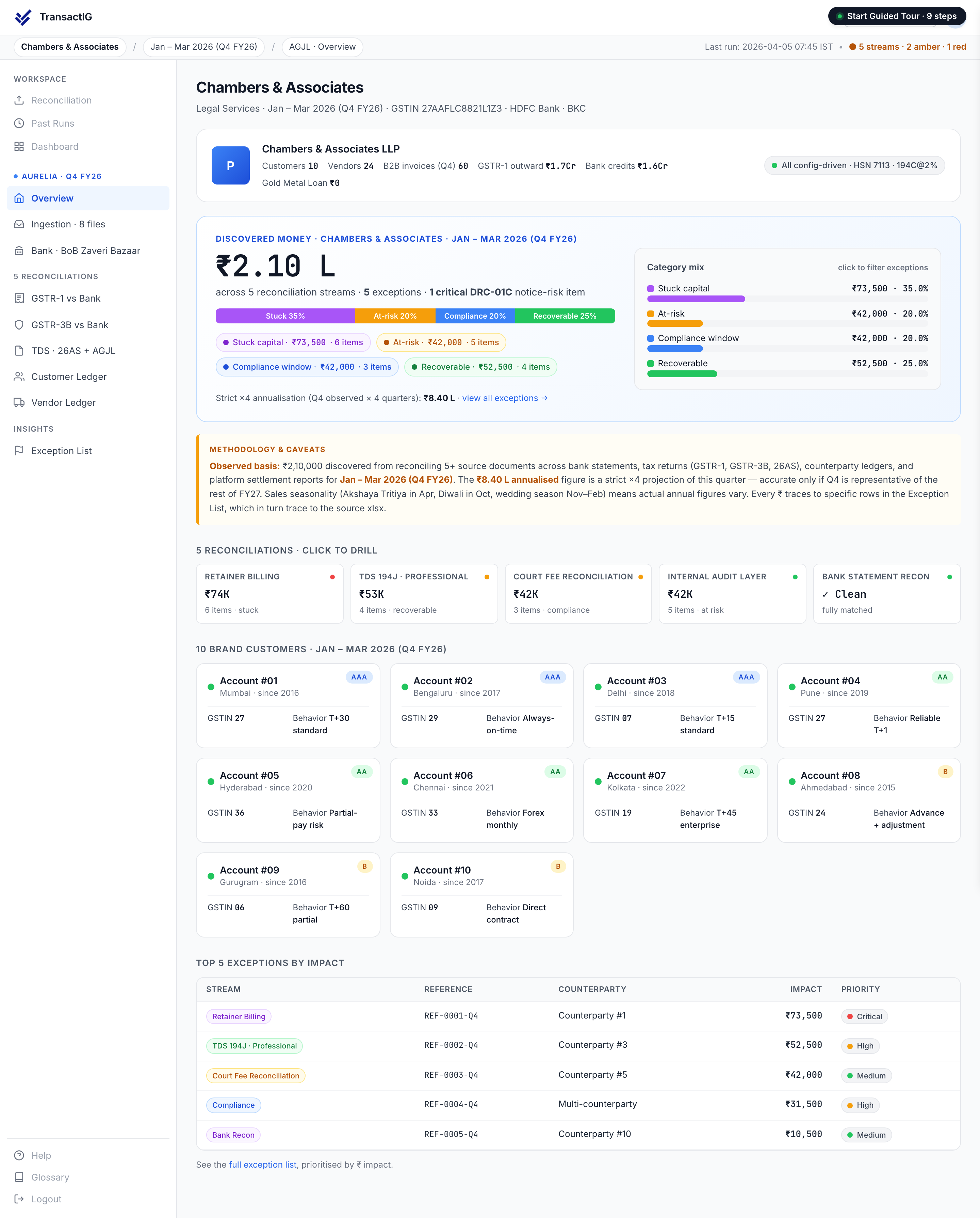
Where reconciliation breaks down
These are the structural problems that generic tools cannot solve for Legal Services businesses.
Retainer vs matter-billed fee reconciliation
Law firms maintain both monthly retainers (fixed) and matter-based billing (variable). When a client remits a consolidated payment covering both retainer and matter invoices, the allocation must be applied correctly to each outstanding — a multi-invoice aggregation problem that few law firm accounting systems handle well.
TDS on professional fees (Section 194J)
All corporate clients deduct TDS at 10% under Section 194J on professional fee payments. Tracking TDS deductions per client, reconciling against Form 26AS, and following up on clients who have not deposited Form 26Q is a quarterly compliance obligation that most law firm accounts teams manage manually.
Disbursement recovery tracking
Court fees, stamp duty, travel expenses, and expert fees advanced by the firm must be recovered from the client. Disbursement accounts per matter can run for 2–4 years before final settlement, and partial recoveries in client payments must be allocated between fees and disbursements correctly.
Client trust account reconciliation
Advances received from clients for future disbursements are held in a client trust (escrow) account, separate from the firm's own funds. Trust account balances must be reconciled per client and per matter, with disbursements deducted as they occur.
How TransactIG solves this
TransactIG is built by Terra Insight with legal services-specific configuration, not generic matching logic.
Matter-wise billing and payment matching
TransactIG matches client receipts against open invoices across retainer and matter bills, allocating partial payments to the oldest invoice first (or per the firm's allocation policy).
Section 194J TDS register
TDS deductions are tracked per client by quarter, matched against Form 16A certificates, and reconciled against Form 26AS — producing a complete TDS credit register for advance tax computation.
Disbursement account reconciliation
Client disbursement accounts are maintained per matter, with advances and actual disbursements tracked — and recovery amounts matched against fee payments to ensure correct allocation.
Reconciliation patterns
Configuration presets
No custom development
These presets are included with every Legal Services deployment of TransactIG. Go live in 2–4 weeks.
Regulatory framework
Legal Services reconciliation in India operates within the following regulatory bodies and compliance frameworks.
Frequently asked questions
Can TransactIG handle a client payment that covers 3 retainer invoices and 2 matter invoices?
Yes. TransactIG identifies the combination of open invoices that matches the remittance and allocates the payment accordingly — per the firm's allocation policy (oldest-first, pro-rata, or manual).
How does TransactIG help when a client has not filed TDS and it is not appearing in Form 26AS?
TransactIG flags TDS deductions that have not appeared in 26AS after a configurable number of days, producing a client-wise list for the accounts team to chase — before the advance tax payment deadline.
We advance court fees and recover them months later. Can TransactIG track matter-wise disbursements?
Yes. Each disbursement is logged against a matter and client. As recovery payments arrive, they are applied to the disbursement balance — with an outstanding disbursement report per matter at any time.
Does TransactIG support a firm that operates across multiple offices in different cities?
Yes. Multi-office reconciliation is supported with office-wise billing and collections, consolidated at the firm level — useful for law firms with Delhi, Mumbai, and Bengaluru offices under a single partnership.
Ready to automate Legal Services reconciliation?
Terra Insight will walk you through a live TransactIG demo using legal services transaction data — matching patterns, variance taxonomy, and ERP integration.