Construction
Reconciliation for EPC contractors, civil construction firms, and project developers
Reconciliation in Construction
Construction and EPC (Engineering, Procurement, Construction) businesses manage the most complex project-level financial flows in Indian business: milestone-based billing against a works contract; advance mobilisation payments from clients that must be recovered against running bills; retention holdbacks from clients as performance security; subcontractor payments with their own retention deductions; and TDS under Section 194C on all works contract payments. A mid-size EPC firm with ₹200 Cr annual revenue manages 30–50 active projects simultaneously, each with its own billing schedule, advance recovery, and retention register — across hundreds of subcontractors.
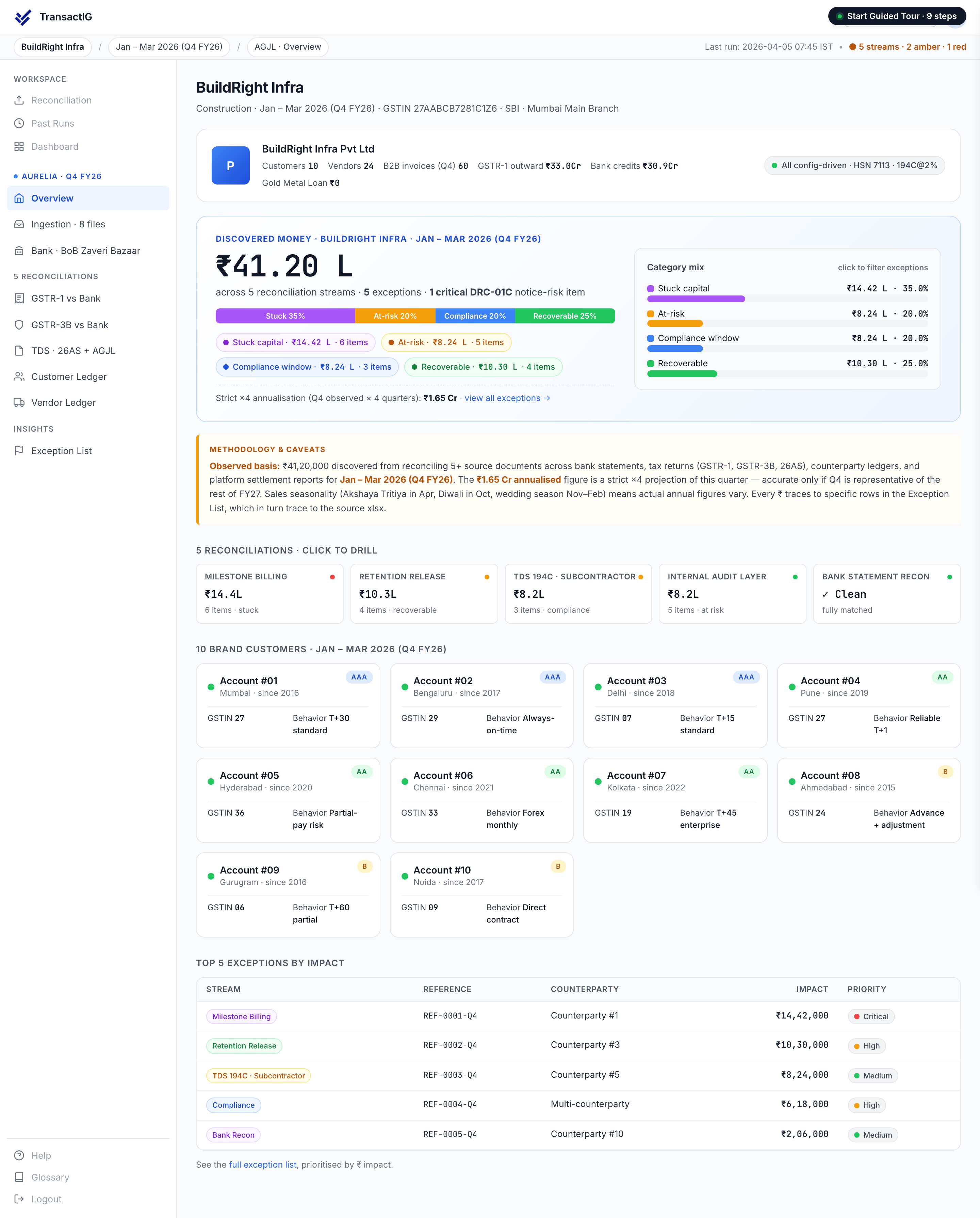
Where reconciliation breaks down
These are the structural problems that generic tools cannot solve for Construction businesses.
Milestone billing vs advance recovery
Clients pay mobilisation advances that are recovered by deducting a percentage (typically 10–15%) from each running account bill. Tracking the advance balance per project — and verifying the correct recovery in each running bill — requires a project-level advance ledger that updates with every payment.
Bilateral retention (client retains from contractor; contractor retains from subcontractor)
Construction firms face retention from both directions: clients retain 5–10% from each running bill until project completion; contractors in turn retain from subcontractors. Tracking two retention registers simultaneously — and ensuring releases coincide correctly — is a common source of disputes and payment delays.
TDS on works contracts (Section 194C)
Both the contractor and subcontractor payment flows attract TDS under Section 194C (2% for companies, 1% for individuals). The contractor both deducts TDS from subcontractor invoices and receives net-of-TDS payments from clients — requiring TDS tracking on both the payable and receivable sides.
Variation order and claim settlement
Scope changes generate variation orders (VOs) that add to the contract value. VO billing is often disputed, delayed, or settled as a lump sum outside the running bill cycle — creating unmatched entries in the project accounts until final settlement.
How TransactIG solves this
TransactIG is built by Terra Insight with construction-specific configuration, not generic matching logic.
Advance recovery tracking
TransactIG maintains a running advance balance per project, deducting the agreed recovery percentage from each running bill and reporting the outstanding advance at any point in time.
Dual retention management
Client retention (receivable) and subcontractor retention (payable) are tracked in separate registers with linked release schedules — preventing mismatched releases and double counting.
Section 194C TDS on both sides
TDS deducted from subcontractors and TDS deducted by clients are tracked in separate ledgers, reconciled against Form 26AS (credit) and TDS returns (liability) respectively.
Reconciliation patterns
Configuration presets
No custom development
These presets are included with every Construction deployment of TransactIG. Go live in 2–4 weeks.
Regulatory framework
Construction reconciliation in India operates within the following regulatory bodies and compliance frameworks.
Frequently asked questions
How does TransactIG track advance recovery across 30 active projects simultaneously?
Each project has an independent advance ledger. Recovery amounts are deducted from running bills as they are entered, with a real-time outstanding balance report per project.
Can TransactIG track both what clients owe us in retention and what we owe subcontractors?
Yes. Client retention (asset) and subcontractor retention (liability) are tracked in separate modules, with release dates and amounts linked to contract completion milestones.
How are variation orders handled when the client has not formally approved them yet?
VOs can be entered as provisional claims with a pending approval status. Once approved, the VO value is added to the contract and the running bill reconciliation is updated retroactively.
We operate projects under multiple SPVs for different clients. Can TransactIG handle multi-entity construction accounting?
Yes. TransactIG supports multi-entity deployment with project-level segmentation across entities and consolidated reporting for the holding company.
Ready to automate Construction reconciliation?
Terra Insight will walk you through a live TransactIG demo using construction transaction data — matching patterns, variance taxonomy, and ERP integration.