Education
Reconciliation for schools, colleges, coaching institutes, and edtech platforms
Reconciliation in Education
Educational institutions collect fees through multiple channels — direct bank transfers, payment gateways (Razorpay, PayU, CCAvenue), demand drafts, and UPI. Edtech platforms additionally manage revenue splits with content partners, affiliate payouts, and scholarship disbursements from government and corporate sponsors. A mid-size school with 3,000 students processes 15,000–20,000 fee transactions per year across multiple fee heads (tuition, hostel, transport, examination). Without structured reconciliation, fee collection gaps, gateway settlement mismatches, and unreconciled scholarships accumulate into balance sheet errors that surface only at audit.
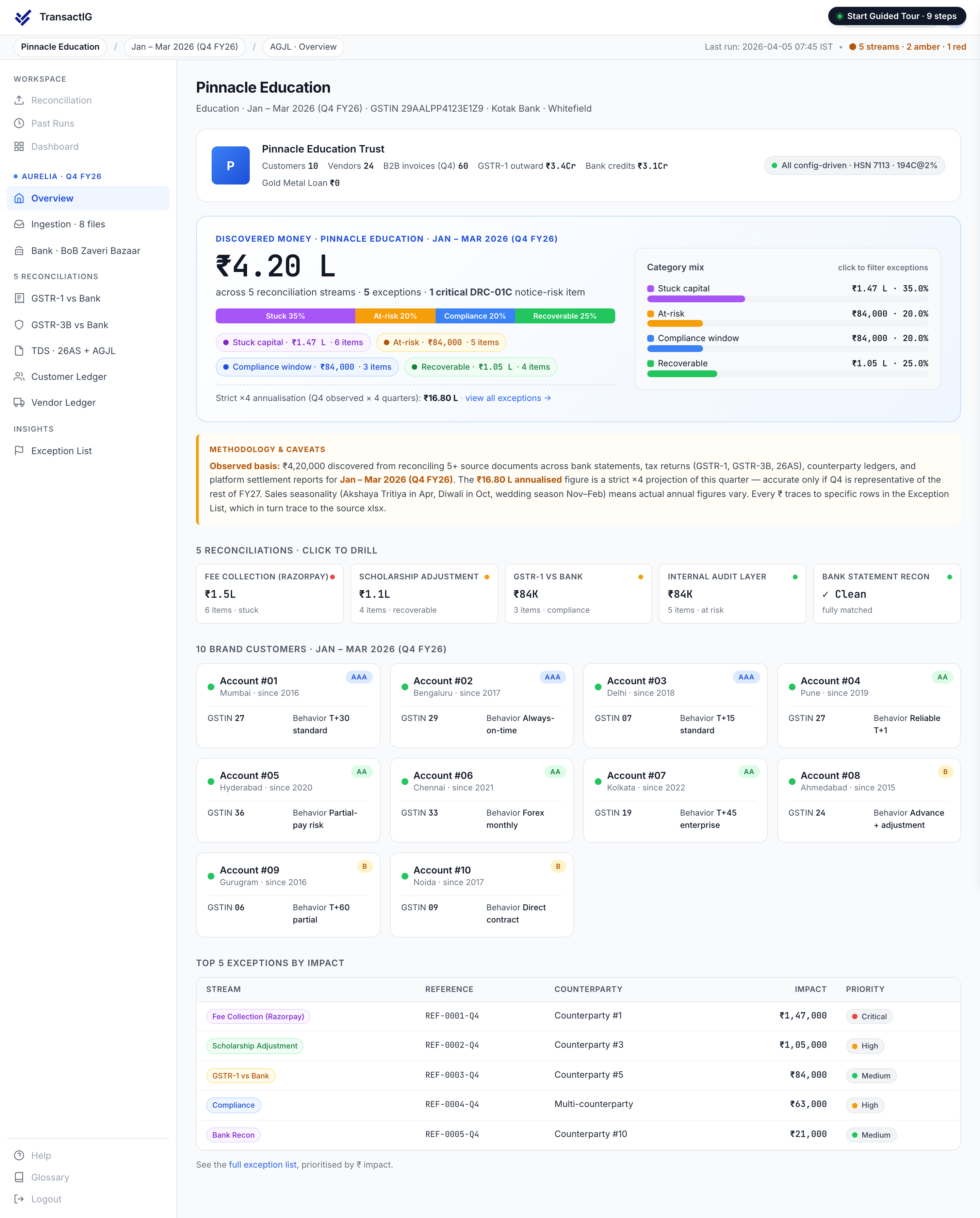
Where reconciliation breaks down
These are the structural problems that generic tools cannot solve for Education businesses.
Multi-head fee collection mismatches
Students pay tuition, hostel, transport, and examination fees in varying combinations and timings. Payment gateways receive consolidated amounts that must be split by fee head in the accounting system — a transformation that cannot be done without configurable disaggregation rules.
Payment gateway settlement lag
Razorpay, PayU, and CCAvenue settle T+2 or T+3, with gateway charges and GST on charges deducted. The settled amount never matches the collected amount, and each gateway uses a different settlement format.
Scholarship and grant reconciliation
Government scholarships (NSP, state schemes) and corporate CSR grants arrive in bulk disbursements that must be matched to individual student fee records. Disbursement delays and partial grants create a perpetual reconciliation backlog.
TDS on edtech platform payouts
Edtech platforms deduct TDS under Section 194J on content creator and faculty payouts. Reconciling net-of-TDS receipts against invoices, and tracking TDS certificates for 26AS, requires tax-aware matching logic.
How TransactIG solves this
TransactIG is built by Terra Insight with education-specific configuration, not generic matching logic.
Fee head disaggregation
TransactIG splits gateway receipts by fee head using configurable allocation rules, matching each component to the corresponding fee demand record in the student information system.
Gateway settlement reconciliation
Pre-built ingestion templates for Razorpay, PayU, and CCAvenue handle gateway charge deductions and GST, matching settled amounts to collection records across the T+2/T+3 lag.
Scholarship disbursement matching
Bulk scholarship credits are disaggregated by student ID and matched against fee outstanding records, with partial and delayed grants classified as named variance types for follow-up.
Reconciliation patterns
Configuration presets
No custom development
These presets are included with every Education deployment of TransactIG. Go live in 2–4 weeks.
Regulatory framework
Education reconciliation in India operates within the following regulatory bodies and compliance frameworks.
Frequently asked questions
Can TransactIG split a single gateway receipt into multiple fee head credits?
Yes. The fee disaggregation module applies configurable allocation rules to split a combined payment into tuition, hostel, transport, and other components — matching each against the corresponding fee demand record.
How does TransactIG handle scholarship disbursements that arrive months after the fee demand?
Scholarship receipts are matched against open fee outstanding records regardless of the time gap, using student ID and scholarship reference as matching keys. Unmatched scholarships are flagged for manual reconciliation.
We use Tally for accounts. Can TransactIG integrate with it?
Yes. TransactIG has a pre-built Tally integration for ledger posting and fee receipt matching. Matched transactions can be written back to Tally automatically.
Does TransactIG handle both school and hostel fee collections in the same instance?
Yes. TransactIG supports multi-revenue-stream reconciliation within a single instance, with separate matching rules per fee type and consolidated reporting for the institution.
Ready to automate Education reconciliation?
Terra Insight will walk you through a live TransactIG demo using education transaction data — matching patterns, variance taxonomy, and ERP integration.