Automotive
Reconciliation for vehicle manufacturers, dealers, and auto ancillary businesses
Reconciliation in Automotive
Automotive OEMs and dealer networks manage a layered financial relationship: OEMs bill dealers for vehicle inventory; dealers collect from retail customers (cash, loan disbursement, exchange value); warranty claims are reimbursed by OEMs after validation; spare parts are distributed through regional distribution centres with credit terms; and sales incentive schemes generate periodic payouts to dealers based on performance. A regional dealer principal managing 3 showrooms processes 800–1,500 vehicle transactions per month, 5,000+ spare parts invoices, and 200–400 warranty claims — each with different payment cycles, deduction structures, and ERP entries.
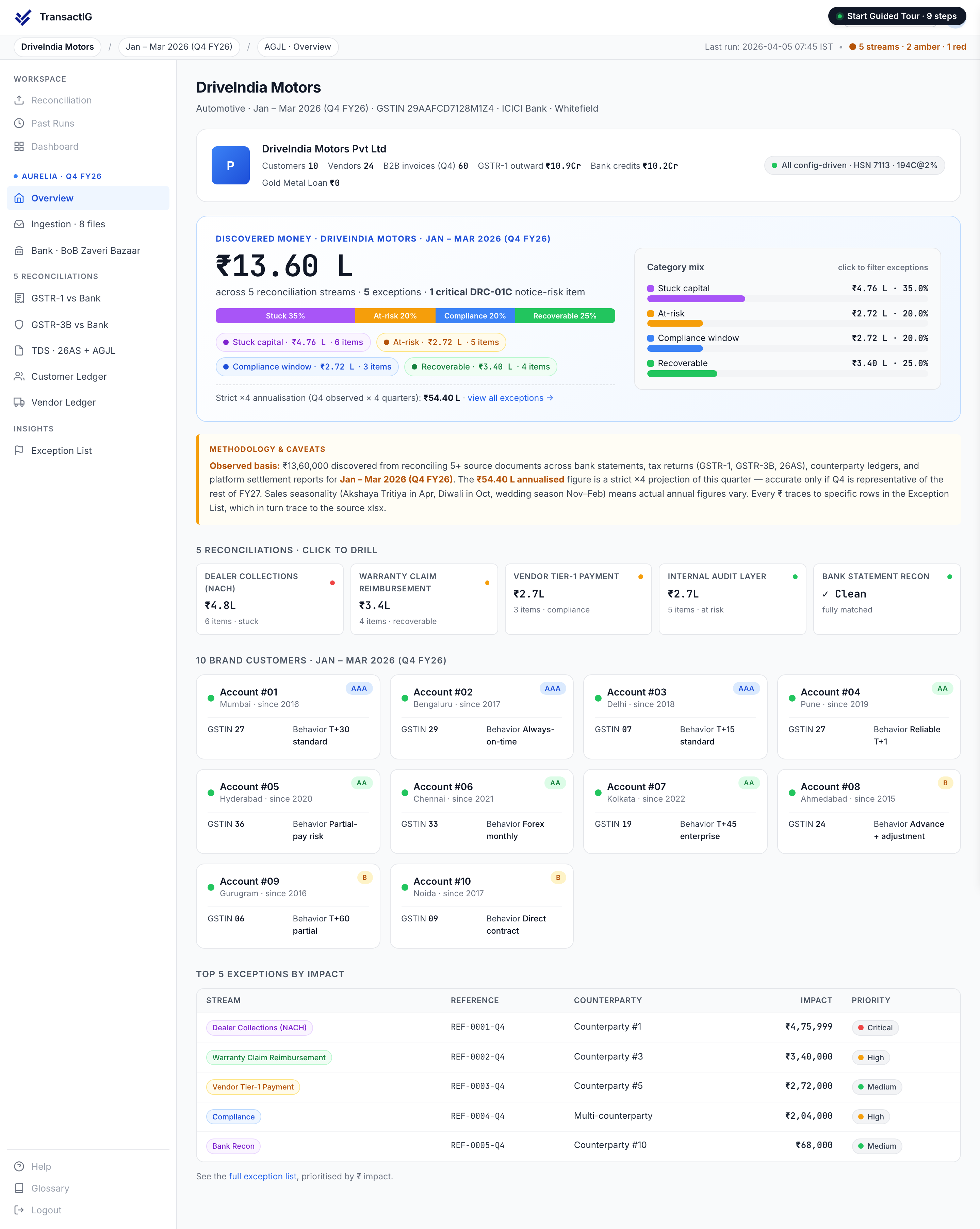
Where reconciliation breaks down
These are the structural problems that generic tools cannot solve for Automotive businesses.
Dealer outstanding and collection matching
OEMs extend floor plan credit to dealers for vehicle inventory. Dealers remit payment upon retail sale — but payment arrives as consolidated bank transfers that must be matched to specific vehicle VINs and invoices. The floor plan interest and PDC management add complexity to an already non-trivial matching problem.
Warranty claim reimbursement reconciliation
Warranty claims submitted by dealers are validated by the OEM and reimbursed in monthly settlement batches with partial approvals, rejections, and clawbacks. Reconciling the settlement against individual claim records — and tracking rejected claims for resubmission — requires batch disaggregation logic.
Sales incentive and dealer scheme payouts
Quarterly dealer incentives (volume bonus, model mix bonus, customer satisfaction bonus) are computed by the OEM and remitted as a single credit. Dealers must reconcile the incentive credit against their own computation of entitlement — a process that is chronically disputed.
Spare parts credit note and return matching
Excess or slow-moving spare parts are returned to the distributor for credit notes. The credit note must be matched against the original purchase invoice, with GST reversal computed correctly — a reconciliation that becomes complex across hundreds of part numbers.
How TransactIG solves this
TransactIG is built by Terra Insight with automotive-specific configuration, not generic matching logic.
Dealer remittance to VIN-level matching
TransactIG matches consolidated dealer remittances against individual vehicle invoices using VIN, chassis number, and invoice date — clearing the floor plan outstanding per unit.
Warranty claim settlement disaggregation
Monthly OEM warranty settlement files are matched against individual warranty claim records, with rejections and clawbacks classified by reason code for targeted resubmission.
Dealer incentive reconciliation
Dealer entitlements are computed from sales data and matched against OEM incentive credits — with disputed amounts classified and escalated to the regional sales manager.
Reconciliation patterns
Configuration presets
No custom development
These presets are included with every Automotive deployment of TransactIG. Go live in 2–4 weeks.
Regulatory framework
Automotive reconciliation in India operates within the following regulatory bodies and compliance frameworks.
Frequently asked questions
Can TransactIG match a single dealer remittance against multiple vehicle invoices?
Yes. The multi-invoice aggregation pattern identifies the combination of open invoices that sums to the remittance amount — within a configurable tolerance for bank charges and interest.
How does TransactIG handle warranty claim rejections that we want to appeal?
Rejected warranty claims are classified with the OEM rejection reason code and flagged for appeal within the configured resubmission window — ensuring no valid claim is missed.
We operate 6 dealerships under one legal entity. Can TransactIG consolidate all?
Yes. TransactIG supports multi-location reconciliation within a single legal entity, with location-wise segmentation and consolidated financial reporting.
Does TransactIG integrate with our DMS (dealer management system)?
TransactIG has integration templates for major DMS platforms including CDK, TechnoSoft, and AutoSoft. Custom integration is available for proprietary DMS systems.
Ready to automate Automotive reconciliation?
Terra Insight will walk you through a live TransactIG demo using automotive transaction data — matching patterns, variance taxonomy, and ERP integration.