Manufacturing
Reconciliation for manufacturers, fabricators, and industrial businesses
Reconciliation in Manufacturing
Manufacturers in India manage complex accounts payable and receivable flows: advance payments to vendors before supply, TDS under Section 194C on job work, TDS under Section 194Q on purchases above ₹50 lakh threshold, retention money held from contractors until project completion, and letter of credit (LC) settlements with domestic and international suppliers. A mid-size manufacturer with ₹100 Cr annual revenue processes 3,000–8,000 purchase invoices and 1,500–4,000 sales invoices per year — each with GST, TDS, and advance adjustment entries that must be cleared accurately for statutory compliance.
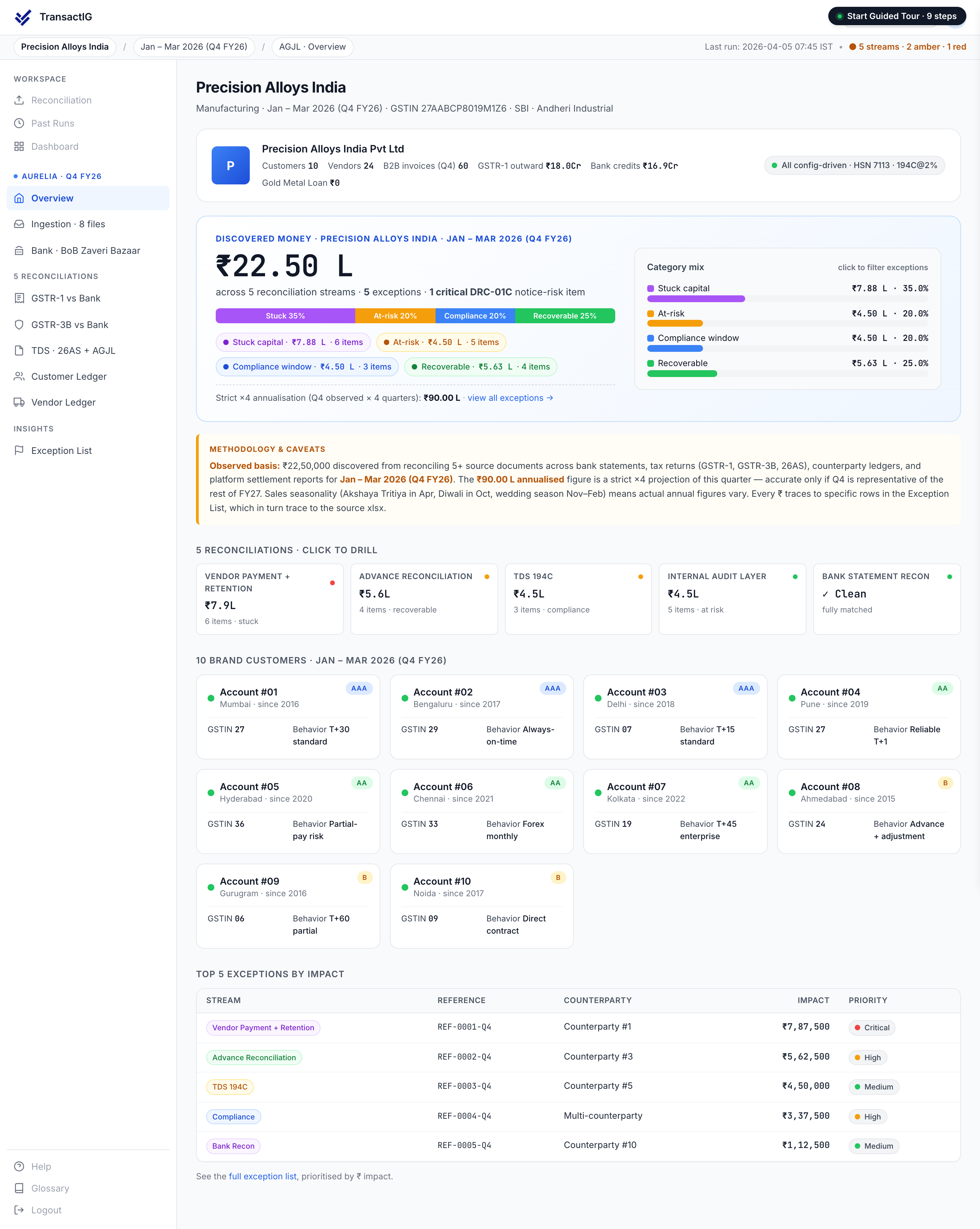
Where reconciliation breaks down
These are the structural problems that generic tools cannot solve for Manufacturing businesses.
Vendor advance and adjustment accounting
Advances paid to vendors before material supply must be adjusted against subsequent invoices. The advance creates a debit balance that must be cleared invoice-by-invoice — a process that standard ERP reconciliation handles poorly when advances are split across partial deliveries.
TDS on job work (Section 194C)
Job work payments to contract manufacturers attract TDS at 2%. Manufacturers must deduct, deposit, and file TDS returns while reconciling net payments against gross invoices — and tracking TDS credit for 26AS against the contractor.
Retention money on contractor payments
Civil and equipment installation contracts typically retain 5–10% of each invoice until project completion and defect-liability expiry. Tracking the retained amount per contractor, per contract, and releasing it on schedule requires a dedicated retention ledger that most ERPs do not provide.
LC settlement and bank charge reconciliation
Letter of credit settlements involve bank charges, devolvements, and forex variance that must be reconciled against the original purchase order value. LC discrepancies that go unreconciled distort landed cost calculations and GST ITC claims.
How TransactIG solves this
TransactIG is built by Terra Insight with manufacturing-specific configuration, not generic matching logic.
Advance and invoice clearing
TransactIG tracks advance balances per vendor and automatically applies them against matching invoices as they arrive — clearing the advance ledger without manual journal entries.
Section 194C TDS management
Job work TDS is computed from the gross invoice, matched against net payments, and tracked per vendor for quarterly TDS return filing and Form 26AS reconciliation.
Retention money ledger
The retention money pattern tracks holdbacks per contract, schedules release dates, and flags overdue releases — giving finance a live view of retention liability without manual spreadsheet tracking.
Reconciliation patterns
Configuration presets
No custom development
These presets are included with every Manufacturing deployment of TransactIG. Go live in 2–4 weeks.
Regulatory framework
Manufacturing reconciliation in India operates within the following regulatory bodies and compliance frameworks.
Frequently asked questions
How does TransactIG handle an advance that is adjusted across 4 invoices over 3 months?
TransactIG maintains a running advance balance per vendor. Each invoice reduces the balance by the adjustment amount, with the remaining advance carried forward — fully auditable with an advance utilisation report.
Can TransactIG track retention money per contract and alert when it is due for release?
Yes. The retention money module stores the contract completion date and defect-liability period, computes the release schedule, and flags overdue retention amounts in the exception report.
We use SAP for manufacturing and Tally for accounts. Can TransactIG bridge both?
Yes. TransactIG can ingest data from SAP production modules and Tally accounts simultaneously, reconciling between systems and identifying mismatches at the transaction level.
Does TransactIG handle GST reconciliation for manufacturing businesses with multiple GST registrations?
Yes. TransactIG supports multi-GSTIN entities, with GSTR-2A/2B reconciliation and ITC tracking per registration — common for manufacturers with plants in multiple states.
Ready to automate Manufacturing reconciliation?
Terra Insight will walk you through a live TransactIG demo using manufacturing transaction data — matching patterns, variance taxonomy, and ERP integration.