Fintech
Reconciliation for payment platforms, lending fintechs, and digital financial services
Reconciliation in Fintech
Fintech companies face the highest-volume reconciliation challenge in Indian business: a mid-size payment gateway processes 5–50 million transactions per month across UPI, cards, net banking, and wallets — each generating a settlement entry that must match the merchant credit in T+1 or T+2. Lending fintechs manage NACH-based EMI collections across a distributed borrower base, nodal account fund flow (PPI guidelines), and co-lending split tracking. Digital wallet and prepaid instrument issuers must maintain wallet balance reconciliation per customer against the nodal account balance — a RBI PPI compliance requirement. The reconciliation infrastructure underpinning these businesses is not a back-office function — it is core infrastructure.
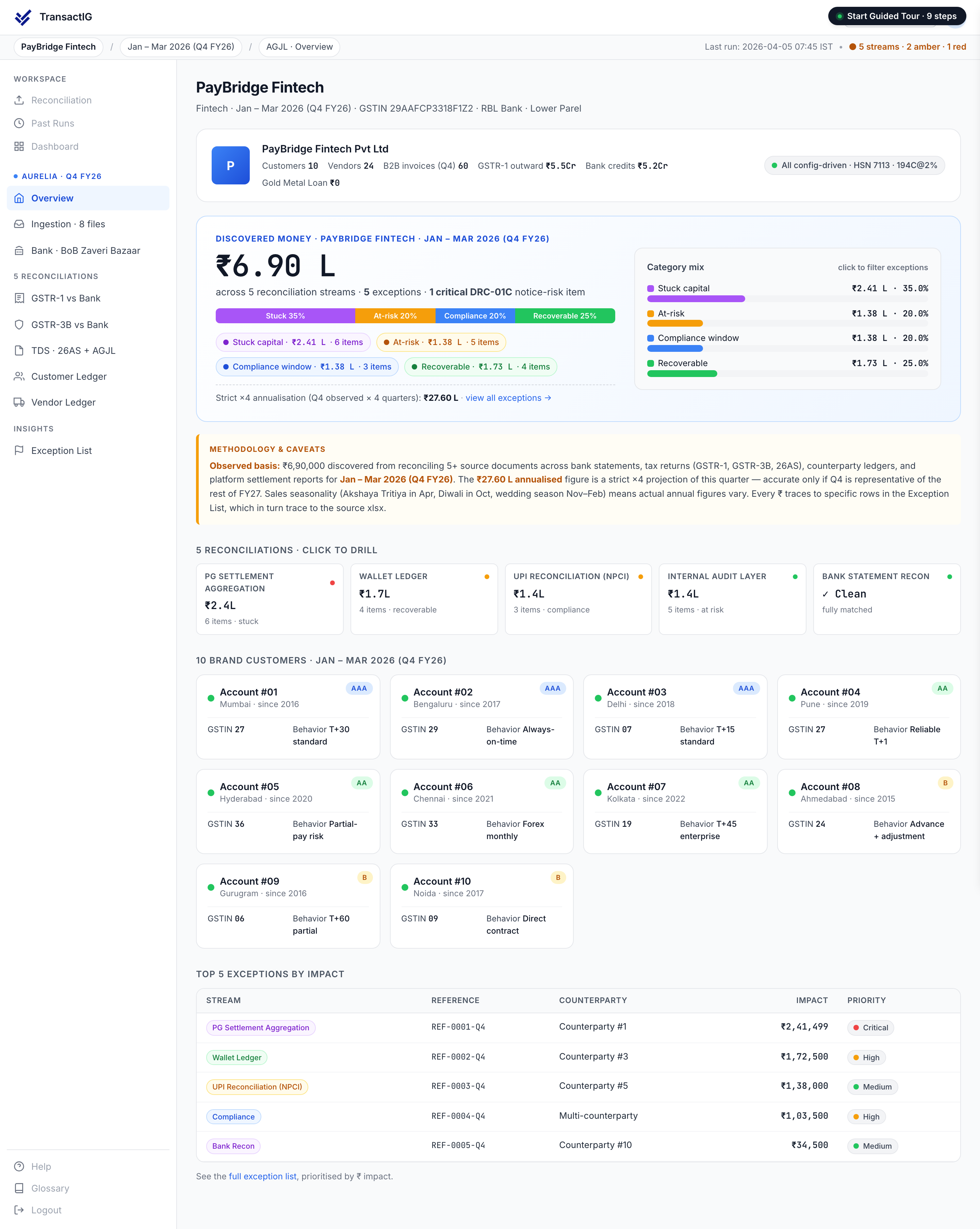
Where reconciliation breaks down
These are the structural problems that generic tools cannot solve for Fintech businesses.
Payment gateway T+1/T+2 settlement mismatch
Merchant settlements are released T+1 or T+2 after transaction date, aggregated across all payment modes. The settlement amount includes charges deductions, refunds processed, and chargebacks — none of which map directly to individual transactions without a structured reconciliation layer.
Nodal account fund flow reconciliation
RBI's PPI guidelines require precise reconciliation between the nodal account (where all customer funds are held) and the sum of outstanding wallet balances. The nodal account reconciliation must be performed daily, with any shortfall immediately reported and remediated.
UPI and multi-mode transaction reconciliation
UPI transactions generate a settlement through NPCI that must be matched against the payment switch's transaction log. Card transactions settle via Visa/Mastercard and must be matched against the acquiring bank's settlement advice. Net banking transactions settle per bank, each with a different file format.
Chargeback and dispute resolution tracking
Card chargebacks and UPI disputes result in settlement debits that must be matched against the original transaction, the merchant's dispute documentation, and the final resolution — across a 30–120 day cycle. Untracked chargebacks result in settlement discrepancies that accumulate into balance sheet exposure.
How TransactIG solves this
TransactIG is built by Terra Insight with fintech-specific configuration, not generic matching logic.
Multi-mode settlement reconciliation
Multi-mode settlement reconciliation — NPCI UPI settlement files, VISA/Mastercard acquirer settlement advices, and net banking settlement files matched against the payment switch transaction log with a daily cleared vs uncleared report — is on the TransactIG roadmap.
Nodal account balance reconciliation
Daily nodal account credits and debits are matched against wallet balance movements and merchant settlements — with any imbalance flagged for immediate resolution per RBI PPI guidelines.
Chargeback lifecycle tracking
Chargebacks are logged at initiation, tracked through dispute stages, and matched against final resolution credits or write-offs — maintaining a complete audit trail per chargeback case.
Reconciliation patterns
Configuration presets
No custom development
These presets are included with every Fintech deployment of TransactIG. Go live in 2–4 weeks.
Regulatory framework
Fintech reconciliation in India operates within the following regulatory bodies and compliance frameworks.
Frequently asked questions
How does TransactIG handle the 50+ million transactions per month our platform processes?
TransactIG is architected for high-throughput batch processing with horizontal scaling on AWS for bank-to-books and TDS reconciliation. Settlement reconciliation at fintech volumes is on the roadmap.
Can TransactIG reconcile NPCI UPI settlement files in the TAT required by RBI?
NPCI UPI settlement-file reconciliation is on the TransactIG roadmap.
How does TransactIG support RBI PPI nodal account compliance?
Nodal account reconciliation is run daily, with a summary report confirming that the nodal account balance equals the sum of outstanding wallet balances — in the format required for RBI inspection.
Can TransactIG handle co-lending fund flows where we split every disbursement with a bank partner?
Yes. The co-lending split configuration applies the agreed ratio to each disbursement and collection, reconciling bank partner payouts and flag deviations from the expected split automatically.
Ready to automate Fintech reconciliation?
Terra Insight will walk you through a live TransactIG demo using fintech transaction data — matching patterns, variance taxonomy, and ERP integration.