Agri & Commodities
Reconciliation for agri-businesses, commodity traders, and food processing companies
Reconciliation in Agri & Commodities
Agri-businesses and commodity trading companies manage procurement (from farmers, FPOs, and mandis), processing or trading, and downstream distribution — each with distinct payment flows and compliance requirements. APMC mandi transactions involve multiple deductions (mandi fee, commission agent fee, weighment charges) from the sale consideration. FPO procurement requires direct farmer payments with income tax considerations. Commodity forward contracts and hedging positions generate settlement flows against commodity exchanges. A mid-size agri-processor with ₹100 Cr annual procurement processes 20,000–50,000 procurement transactions per year — most paid directly to farmers, FPOs, or commission agents with same-day settlement.
Where reconciliation breaks down
These are the structural problems that generic tools cannot solve for Agri & Commodities businesses.
APMC mandi settlement reconciliation
Mandi transactions involve the OEM seller, the commission agent (arhatiya), and the buyer. Payments flow through the arhatiya with mandi fee, commission, and other deductions applied. Reconciling the net amount received against the expected proceeds — per lot, per mandi — requires a multi-deduction matching framework that standard accounting cannot provide.
Direct farmer and FPO payment reconciliation
Procurement from farmers and FPOs via direct bank transfer (NEFT/RTGS/UPI) must be matched against procurement records per village, per commodity, and per purchase date. High volumes and fragmented sourcing geography create a daily reconciliation backlog.
Commodity exchange settlement
Hedging and trading positions on MCX (multi commodity exchange) generate daily mark-to-market margin calls and quarterly delivery settlement. Reconciling exchange settlement credits and debits against the trading book requires exchange-format ingestion and P&L attribution.
GST on agricultural transactions
Agricultural commodities have complex GST treatment: most raw commodities are GST-exempt; processed commodities attract GST; input services (transportation, storage, cold chain) attract GST with ITC implications. Tracking GST across the exempt/taxable supply mix is a compliance challenge specific to agri-businesses.
How TransactIG solves this
TransactIG is built by Terra Insight with agri & commodities-specific configuration, not generic matching logic.
Mandi settlement disaggregation
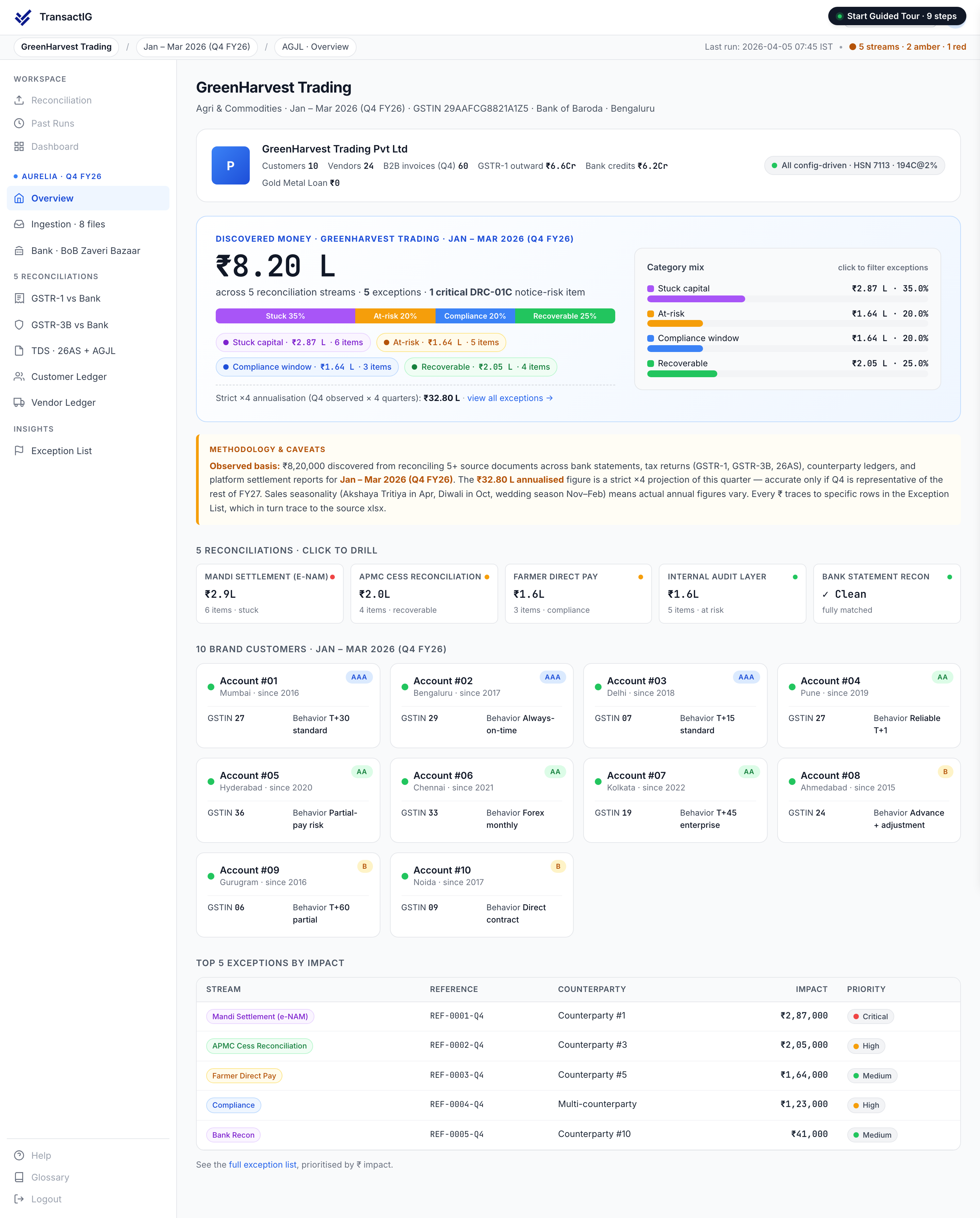
TransactIG ingests mandi account statements and disaggregates net proceeds by lot, applying mandi fee, commission, and weighment deductions as named variance categories — matching against procurement records per lot.
Farmer payment batch matching
NEFT/RTGS farmer payment batches are matched against procurement records by farmer ID, village, commodity, and weight — with unmatched payments flagged for field verification.
MCX exchange settlement reconciliation
Daily MCX settlement statements are ingested and matched against the commodity trading book, with margin calls, MTM credits/debits, and delivery settlements classified as named transaction types.
Reconciliation patterns
Configuration presets
No custom development
These presets are included with every Agri & Commodities deployment of TransactIG. Go live in 2–4 weeks.
Frequently asked questions
How does TransactIG handle the multiple deductions in an APMC mandi transaction?
Each deduction type (mandi fee, arhatiya commission, weighment, hamali) is configured as a named deduction category. TransactIG applies each deduction rule and reconciles the net proceeds against the expected amount per lot.
Can TransactIG track payments to 5,000 farmers across 200 villages?
Yes. Farmer payment records are tracked by farmer ID, village, and procurement season. The matching report shows paid vs outstanding per farmer with a geographic summary.
Does TransactIG support eNAM portal data integration?
TransactIG can ingest eNAM transaction data via file export and reconcile against procurement records — supporting the digital mandi reconciliation mandate.
How does TransactIG handle GST ITC for a company that buys exempt commodities and sells both exempt and taxable products?
Per-transaction classification of input and output supplies sits within GSTR-1 / GSTR-3B outward reconciliation, which leads the TransactIG GST roadmap. The ITC computation on common inputs (proportionate method) and the GSTR-9 annual workbook are on the roadmap alongside the forthcoming inward-side GST capability.
Ready to automate Agri & Commodities reconciliation?
Terra Insight will walk you through a live TransactIG demo using agri & commodities transaction data — matching patterns, variance taxonomy, and ERP integration.